
 By
By
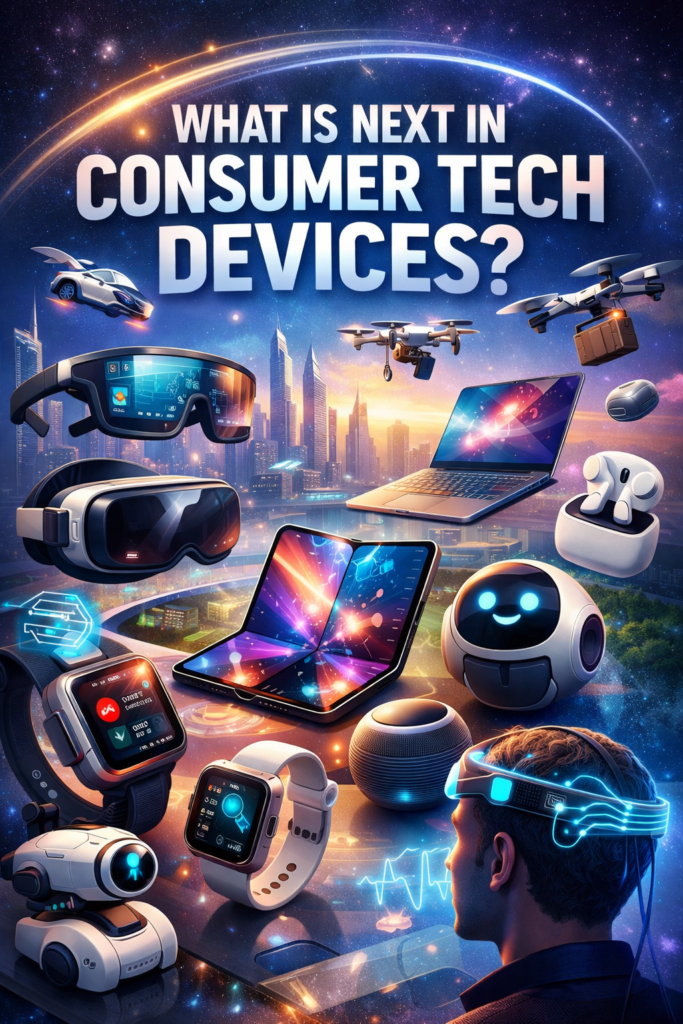
Introduction: Why Everyone Is Asking What Is Next in Consumer Tech Devices
Consumer technology is entering a new phase. For years, innovation meant faster processors, better cameras, and thinner designs. Today, those improvements still matter, but they are no longer enough to excite users or transform behavior. This is why so many consumers, brands, and investors are asking the same question: what is next in consumer tech devices?
The next wave of consumer tech is not about owning more gadgets. It is about devices becoming smarter, more personal, and more invisible. Instead of asking users to adapt to technology, modern consumer tech devices are being designed to adapt to people. Artificial intelligence, advanced sensors, and always-on connectivity are turning everyday devices into proactive assistants rather than passive tools.
Another reason interest is rising is technology fatigue. Many consumers feel overwhelmed by constant notifications, app overload, and frequent hardware upgrades. The future of consumer tech devices is responding to this problem by focusing on automation, context awareness, and reduced friction. The goal is simple: technology that quietly improves daily life without demanding attention.
From AI-powered smartphones and health-focused wearables to smart homes that learn behavior patterns, the next generation of consumer tech devices is reshaping how people live, work, and interact with the digital world. Understanding what is next helps consumers make smarter buying decisions and helps businesses prepare for where demand is heading.
In this guide, you’ll learn:
- What “next-generation consumer tech devices” really means
- The major forces shaping the future of consumer technology
- Which device categories will change the most
- How AI is redefining consumer hardware
- What challenges could slow adoption
This article gives you a clear, practical, and forward-looking view of what is next in consumer tech devices—without hype, jargon, or guesswork.
What Does “Next in Consumer Tech Devices” Really Mean?
When people search for what is next in consumer tech devices, they are not looking for a single gadget or product. They are trying to understand how consumer technology is fundamentally changing. The “next” in consumer tech refers to a shift in how devices behave, interact, and deliver value, not just how they look or perform on a spec sheet.
At its core, next-generation consumer tech devices share three defining traits:
- They are intelligent, powered by AI and machine learning
- They are context-aware, understanding user behavior and environment
- They are proactive, acting before the user explicitly asks
This marks a clear break from traditional consumer electronics, which relied heavily on manual input and fixed functions.
From Feature-Based Devices to Experience-Based Consumer Tech
In the past, consumer tech devices competed on features:
- More megapixels
- Faster CPUs
- Larger screens
- More storage
While these specs still matter, they no longer drive differentiation. Today’s competition is about experience quality.
Modern consumer tech devices are designed around:
- Personalization instead of generic settings
- Automation instead of constant interaction
- Ecosystems instead of standalone products
For example, a next-generation smartphone does not just take better photos. It:
- Knows when to enhance images automatically
- Adjusts battery usage based on daily habits
- Integrates seamlessly with wearables, cars, and smart homes
This shift explains why software updates often feel more impactful than hardware changes.
Incremental Innovation vs. Breakthrough Consumer Tech Devices
Not all new devices represent what is truly “next” in consumer tech. It helps to separate incremental upgrades from breakthrough innovation.
| Incremental Innovation | Next-Gen Consumer Tech |
|---|---|
| Slightly faster chips | AI-driven behavior changes |
| Better displays | New interaction models |
| More sensors | Meaningful insights from data |
| Cosmetic redesigns | Functional form-factor shifts |
A good rule of thumb:
If a device requires less effort from the user over time, it is moving toward the future of consumer tech.
Why AI Is the Foundation of What Is Next in Consumer Tech Devices
Artificial intelligence is no longer an add-on feature. It is the core operating layer of modern consumer tech devices.
AI enables:
- Real-time personalization without manual setup
- Predictive actions based on historical behavior
- Natural interactions through voice, gestures, and vision
According to industry data, over 70% of new consumer devices launched in the last two years include some form of embedded AI, either on-device or cloud-assisted. This trend is accelerating as AI chips become more efficient and affordable.
Importantly, the future is shifting toward on-device AI, which:
- Improves privacy
- Reduces latency
- Works without constant internet access
This is a major reason why consumer tech devices are becoming more trustworthy and reliable.
The Role of Timing in Consumer Tech Adoption
Understanding what is next in consumer tech devices also means understanding when technology becomes usable, not just when it becomes possible.
Many innovations fail because they arrive before:
- Hardware is affordable
- Battery life is sufficient
- Software ecosystems mature
- Consumer behavior is ready
A clear example is smart glasses. Early versions struggled due to poor design, limited battery life, and social discomfort. Today, improvements in miniaturization, AI vision, and contextual computing are bringing this category closer to mainstream acceptance.
“Consumer technology succeeds when it fits naturally into daily life, not when it demands attention.”
— Industry design principle
Summary: What “Next” Really Signals in Consumer Tech Devices
When people ask what is next in consumer tech devices, they are really asking:
- How will technology become more helpful and less distracting?
- Which devices will quietly replace multiple tools?
- How will AI change everyday interactions?
The answer is clear: the future of consumer tech is adaptive, intelligent, and increasingly invisible. Devices will do more while asking less from users.
Key Forces Driving What’s Next in Consumer Tech Devices
To understand what is next in consumer tech devices, it is critical to look beyond individual products and focus on the forces shaping the entire industry. Consumer technology does not evolve randomly. It moves in response to breakthroughs in computing, changes in consumer behavior, and shifts in economic and regulatory conditions.
Several powerful forces are converging at the same time. Together, they are redefining how consumer tech devices are built, marketed, and used.
Artificial Intelligence Is Becoming the Core of Consumer Tech Devices
Artificial intelligence is no longer a feature layered on top of hardware. It is becoming the central nervous system of consumer tech devices.
Modern AI enables devices to:
- Learn from user behavior over time
- Adapt interfaces dynamically
- Anticipate needs instead of reacting
This change is visible across categories. Smartphones optimize performance automatically. Wearables detect health patterns without user input. Smart home devices adjust environments based on routines rather than schedules.
A major shift is the move from cloud-dependent AI to on-device AI.
On-device AI advantages include:
- Faster response times
- Improved privacy and data control
- Reduced reliance on internet connectivity
According to semiconductor industry reports, AI-capable consumer chips are now shipping in hundreds of millions of devices annually, making advanced intelligence accessible at mass-market scale.
Hardware and Software Are Merging Faster Than Ever
Another major force shaping what is next in consumer tech devices is the tight integration of hardware and software. In the past, devices were sold as finished products. Today, they are living platforms that evolve over time.
This shift has several implications:
- Devices improve through software updates
- Features can be unlocked post-purchase
- Hardware lifecycles are extending
Instead of asking, “What does this device do today?” consumers are increasingly asking, “What will this device be able to do in two years?”
Examples of this shift include:
- Cameras improving through computational photography
- Wearables gaining new health features via firmware
- Smart TVs evolving into full content platforms
This convergence also enables new business models, such as:
- Subscription-based features
- AI-powered premium services
- Cross-device ecosystems
Consumer Demand for Seamless, Connected Experiences
Consumers no longer evaluate devices in isolation. They expect everything to work together.
This is why ecosystems are becoming more important than individual specs. A single consumer tech device may be impressive, but its real value is unlocked when it connects effortlessly with others.
Key expectations driving this trend include:
- Automatic syncing across devices
- Unified accounts and identities
- Consistent user experiences
For example:
- A smartwatch should unlock a phone
- A phone should control a car or home
- A home should respond to who is present
This demand is pushing companies to design devices that prioritize interoperability and standards, rather than proprietary lock-in.
Sensors, Data, and Context Are Fueling Smarter Devices
Next-generation consumer tech devices rely heavily on advanced sensors. These sensors capture data about motion, location, environment, and biometrics.
However, sensors alone are not the innovation. The real change comes from contextual interpretation.
Modern devices can now understand:
- Where you are
- What you are doing
- What you typically do next
This allows consumer tech devices to move from:
“User-controlled” → “Context-driven”
For example:
- Noise-canceling headphones adjust automatically based on surroundings
- Displays change brightness and tone based on time of day
- Health devices detect anomalies instead of just recording metrics
Market Maturity Is Forcing Meaningful Innovation
Many consumer tech categories are mature. Smartphone ownership is nearly universal in developed markets. Basic smart home adoption is widespread. This saturation is forcing companies to innovate qualitatively, not quantitatively.
Instead of asking:
- How do we sell more devices?
Companies are asking:
- How do we make devices indispensable?
This pressure is accelerating:
- AI integration
- New form factors
- Deeper personalization
Only consumer tech devices that deliver ongoing value will stand out in crowded markets.
Summary: Why These Forces Matter
The future of consumer technology is being shaped by:
- AI as a foundational layer
- Deep hardware-software integration
- Demand for seamless ecosystems
- Context-aware intelligence
- Market pressure for real differentiation
Together, these forces explain why the next generation of consumer tech devices will feel fundamentally different from what came before.
What Is Next in Consumer Tech Devices for Smartphones?
Smartphones sit at the center of the consumer tech ecosystem, which makes them one of the clearest indicators of what is next in consumer tech devices. While annual hardware upgrades are slowing, the smartphone is not losing relevance. Instead, it is evolving into something more intelligent, more adaptive, and more central to daily life.
The future of smartphones is less about raw power and more about how effectively that power is used.
AI-First Smartphones Are Replacing App-First Experiences
One of the biggest shifts in smartphones is the move from app-centric design to AI-first interfaces.
Traditionally, users:
- Opened apps
- Searched for features
- Manually triggered actions
Next-generation smartphones reverse this model. AI systems now sit above apps and act as orchestrators.
AI-first smartphones can:
- Surface information before it is requested
- Automate routine actions
- Understand context across multiple apps
For example:
- A phone can suggest leaving early based on traffic patterns
- Messages can be summarized automatically
- Photos are organized and enhanced without manual editing
This shift reduces friction and changes how people interact with their devices.
On-Device Intelligence Is Becoming a Competitive Advantage
Privacy and speed concerns are accelerating the move toward on-device AI processing.
Unlike cloud-based systems, on-device AI:
- Processes data locally
- Responds instantly
- Keeps sensitive information private
This is especially important for:
- Voice recognition
- Image analysis
- Health and biometric data
Industry benchmarks show that modern smartphone chips now include dedicated AI engines capable of trillions of operations per second. This makes advanced intelligence available even without an internet connection.
As a result, smartphones are becoming trusted personal devices, not just gateways to online services.
Foldables, Rollables, and New Smartphone Form Factors
Another key signal of what is next in consumer tech devices is experimentation with form factors.
Traditional slab smartphones have reached design maturity. To unlock new use cases, manufacturers are exploring:
- Foldable displays
- Rollable screens
- Modular designs
These new form factors aim to:
- Combine phone and tablet functionality
- Improve multitasking
- Enable immersive content consumption
While early foldables faced durability and cost challenges, newer generations are:
- Thinner
- Stronger
- More energy-efficient
Adoption is still early, but form-factor innovation is laying the groundwork for more flexible computing experiences.
Smartphones as the Control Hub for Consumer Tech Devices
As other consumer tech devices multiply, smartphones are becoming the central command center.
Modern smartphones now function as:
- Smart home controllers
- Health dashboards
- Digital wallets
- Security and identity hubs
This role is expanding with features such as:
- Car key integration
- Digital IDs
- Secure authentication across devices
In practice, this means:
- One device manages many
- Interactions become simpler
- Ecosystems become more cohesive
The smartphone is evolving from a standalone product into a personal technology hub.
Battery, Efficiency, and Sustainability Improvements
Consumers want smarter devices without sacrificing battery life. This demand is driving innovation in:
- AI-driven power management
- More efficient chip architectures
- Smarter background processing
Instead of bigger batteries, smartphones are learning how to use energy more intelligently.
Sustainability is also shaping smartphone design:
- Longer software support lifecycles
- Recycled materials
- Repair-friendly construction
These changes reflect broader consumer expectations around responsible technology.
Summary: The Smartphone’s Role in the Next Wave of Consumer Tech
The smartphone is not being replaced. It is being redefined.
In the context of what is next in consumer tech devices, smartphones are:
- Becoming AI-first platforms
- Serving as ecosystem hubs
- Adopting new physical forms
- Prioritizing privacy and efficiency
Rather than disappearing, smartphones are becoming more powerful by doing more behind the scenes and demanding less attention from users.
The Future of Wearable Consumer Tech Devices
Wearables are one of the fastest-evolving categories shaping what is next in consumer tech devices. What began as basic fitness trackers has expanded into a broad ecosystem of health, wellness, productivity, and ambient computing devices. The future of wearables is defined by deeper intelligence, smaller form factors, and more meaningful insights.
Rather than simply collecting data, next-generation wearable consumer tech devices are designed to interpret data and take action.
Health-Focused Wearables Are Moving Beyond Fitness Tracking
Early wearables focused on steps, calories, and heart rate. While these metrics are still useful, they only scratch the surface of what wearables can do.
Modern health-focused wearables now monitor:
- Heart rhythm irregularities
- Blood oxygen levels
- Sleep stages and recovery
- Stress and nervous system activity
The next phase goes further by emphasizing long-term health trends rather than daily stats.
Key developments in wearable health tech include:
- Early detection of cardiovascular issues
- Continuous temperature and metabolic monitoring
- Passive health insights without user input
According to healthcare technology studies, continuous monitoring can identify health anomalies weeks earlier than traditional checkups. This positions wearables as preventive health tools, not just fitness accessories.
Smart Rings, Smart Glasses, and the Rise of Invisible Tech
One of the clearest signals of what is next in consumer tech devices is the move toward smaller, less intrusive wearables.
Smart rings and minimal wearables are gaining popularity because they:
- Are comfortable to wear all day
- Blend naturally into daily life
- Focus on background data collection
These devices prioritize:
- Sleep and recovery tracking
- Stress and readiness metrics
- Long battery life
At the same time, smart glasses are re-emerging with a new focus on practicality.
Unlike earlier attempts, modern smart glasses emphasize:
- Lightweight design
- Audio-first interactions
- Context-aware notifications
Instead of replacing smartphones, these wearables aim to reduce screen dependence.
What Is Next for AR Glasses and Head-Mounted Consumer Devices?
Augmented reality remains one of the most anticipated areas in consumer tech, but adoption has been slower than expected. This is not due to lack of interest, but rather technical and social constraints.
Challenges that are now being addressed include:
- Battery life limitations
- Heat and comfort issues
- Social acceptance
The next generation of AR wearables is shifting toward:
- Short, purposeful interactions
- Navigation and real-time assistance
- Hands-free access to information
Rather than full immersion, the focus is on useful augmentation.
“The future of AR is not about replacing reality, but enhancing it at the right moments.”
This restrained approach increases the likelihood of mainstream adoption.
AI and Personalization in Wearable Consumer Tech Devices
AI is transforming wearables from passive trackers into personal health and lifestyle assistants.
AI-powered wearables can:
- Detect patterns humans might miss
- Adapt recommendations over time
- Provide actionable insights instead of raw data
For example:
- A wearable might recommend rest based on recovery trends
- Stress alerts may trigger breathing exercises
- Sleep advice evolves with lifestyle changes
This level of personalization makes wearables more valuable over time, not less.
Battery Life and Comfort Are Now Top Priorities
As wearables become more capable, efficiency becomes critical. Consumers expect:
- Multi-day battery life
- Lightweight designs
- Minimal maintenance
To meet these expectations, manufacturers are focusing on:
- Low-power sensors
- Efficient AI processing
- Simplified interfaces
The goal is to make wearables feel effortless, not demanding.
Summary: Why Wearables Define What Is Next in Consumer Tech Devices
Wearable consumer tech devices are evolving into:
- Preventive health tools
- Ambient computing interfaces
- Personalized assistants
They represent a future where technology is always present but rarely intrusive.
In many ways, wearables are the clearest example of where consumer tech is heading: smarter, quieter, and more human-centered.
What Is Next in Smart Home Consumer Tech Devices?
Smart homes are quickly becoming one of the most important categories when discussing what is next in consumer tech devices. Early smart home products focused on basic automation, such as turning lights on and off remotely. The next generation is far more ambitious. Smart homes are evolving into adaptive environments that learn, predict, and respond automatically.
The future of smart home consumer tech devices is not about adding more gadgets. It is about creating homes that understand the people inside them.
Homes That Learn and Adapt Automatically
The biggest shift in smart home technology is the move from rule-based automation to AI-driven adaptation.
Traditional smart homes rely on:
- Manual schedules
- Explicit commands
- Predefined routines
Next-generation smart home devices use AI to:
- Learn daily patterns
- Adjust settings dynamically
- Respond to real-world conditions
For example:
- Heating systems adjust based on occupancy and weather
- Lighting adapts to time of day and activity
- Security systems recognize familiar faces
This makes smart homes feel less like systems and more like living environments.
Predictive Automation and Energy Efficiency
Energy management is a major driver of innovation in smart home consumer tech devices. Rising energy costs and sustainability concerns are pushing smarter solutions.
AI-powered smart homes can:
- Predict energy usage
- Optimize heating and cooling
- Shift power consumption to off-peak hours
Benefits of predictive automation include:
- Lower utility bills
- Reduced environmental impact
- Improved comfort
According to energy efficiency studies, AI-driven home automation can reduce energy usage by 10–20% without sacrificing comfort.
Interoperability and the End of Smart Home Silos
One of the biggest frustrations with early smart home devices was fragmentation. Different brands often required separate apps and ecosystems.
This is changing rapidly with the adoption of universal standards like Matter.
Why interoperability matters:
- Devices from different brands work together
- Setup is simpler
- Consumers are not locked into one ecosystem
As interoperability improves, smart home technology becomes more accessible and less intimidating for everyday users.
Privacy and Security in Smart Home Consumer Tech Devices
As smart homes collect more data, privacy and security become critical concerns.
The next wave of smart home consumer tech devices is addressing this by:
- Processing data locally instead of in the cloud
- Offering granular privacy controls
- Providing transparent data usage policies
Security improvements include:
- Encrypted communication
- Biometric authentication
- Automatic threat detection
Trust is becoming a key differentiator in smart home adoption.
Voice, Gesture, and Ambient Interfaces
Smart homes are also moving beyond screens and apps. Interaction methods are becoming more natural and less intrusive.
Emerging interfaces include:
- Voice commands with contextual understanding
- Gesture-based controls
- Presence-aware automation
For example:
- Lights adjust when someone enters a room
- Music follows users through the house
- Devices respond without spoken commands
This shift supports the broader trend toward ambient computing.
Smart Homes as Part of a Larger Consumer Tech Ecosystem
Smart homes do not exist in isolation. They are increasingly integrated with:
- Smartphones
- Wearables
- Vehicles
- Energy grids
This creates a unified consumer tech ecosystem where devices share context and intelligence.
For instance:
- A wearable detects sleep patterns and adjusts home temperature
- A car communicates arrival time to the home
- Energy systems coordinate with appliances
The home becomes a responsive hub rather than a collection of devices.
Summary: The Smart Home’s Role in the Future of Consumer Tech
Smart home consumer tech devices are evolving from simple automation tools into adaptive living systems.
They represent:
- Intelligence embedded in the environment
- Seamless interaction without constant input
- A major step toward invisible technology
When people ask what is next in consumer tech devices, smart homes provide one of the clearest answers: technology that quietly improves daily life behind the scenes.
The Rise of AI-Powered Consumer Tech Devices
Artificial intelligence is the single most important factor shaping what is next in consumer tech devices. While AI once lived primarily in software applications and cloud services, it is now deeply embedded in everyday consumer hardware. This shift is transforming devices from tools that respond to commands into systems that understand, anticipate, and assist.
AI-powered consumer tech devices are redefining how people interact with technology—often without realizing it.
Personal AI Assistants Built Into Everyday Consumer Devices
Voice assistants were an early attempt at consumer AI, but they were limited by rigid commands and cloud dependency. The next generation of AI-powered consumer tech devices goes far beyond voice control.
Modern personal AI assistants are:
- Context-aware
- Multimodal (voice, text, vision)
- Integrated across devices
Instead of asking a device to perform a task, users increasingly experience suggestions and automated actions.
Examples include:
- Calendar adjustments based on travel delays
- Smart replies that reflect communication style
- Automatic organization of photos, files, and messages
These assistants are evolving into digital companions that understand preferences and routines.
Consumer Devices That Proactively Solve Problems
One of the most important changes in AI-powered consumer tech devices is proactive problem-solving.
Traditional devices wait for input. Next-generation devices anticipate needs.
This is made possible through:
- Behavioral pattern analysis
- Sensor data interpretation
- Predictive modeling
For example:
- A wearable may suggest rest before fatigue sets in
- A phone may silence notifications during focus periods
- A home may adjust lighting based on mood and activity
This reduces cognitive load and helps users stay focused on what matters.
On-Device AI Is Changing Privacy and Performance Expectations
As AI becomes more powerful, consumers are demanding better privacy controls. This is accelerating the adoption of on-device AI processing.
Benefits of on-device AI in consumer tech devices include:
- Data stays on the device
- Faster decision-making
- Reduced reliance on cloud services
This is particularly important for:
- Facial recognition
- Health monitoring
- Personal communications
By keeping intelligence local, consumer tech devices feel more secure and more responsive.
AI Customization Without Complexity
One challenge with advanced technology is usability. The future of AI-powered consumer tech devices is focused on simplicity.
Instead of asking users to configure settings, AI systems learn naturally over time.
This includes:
- Passive learning from behavior
- Adaptive interfaces
- Minimal manual input
The result is technology that feels intuitive rather than technical.
AI as a Differentiator in Competitive Consumer Tech Markets
As hardware capabilities converge, AI is becoming the primary differentiator among consumer tech brands.
Companies are competing on:
- Quality of personalization
- Accuracy of predictions
- Trust and transparency
Consumers are beginning to choose devices not just for design or price, but for how intelligently they adapt to individual needs.
Summary: Why AI Defines What Is Next in Consumer Tech Devices
AI-powered consumer tech devices represent a shift from:
- Reactive → proactive
- Generic → personalized
- Manual → automated
This transition is central to understanding what is next in consumer tech devices. AI is no longer optional—it is the foundation upon which the future of consumer technology is being built.
What Is Next in Consumer Tech Devices for Entertainment and Media?
Entertainment and media have always pushed consumer technology forward. From televisions and gaming consoles to streaming devices and headphones, this category often shows what is next in consumer tech devices before other markets catch up. Today, entertainment tech is evolving toward immersion, personalization, and interactivity.
The future of entertainment is not just about higher resolution or louder sound. It is about how content is experienced and adapted to each user.
Immersive Entertainment Experiences Are Becoming the Standard
Traditional screens and speakers are being enhanced by technologies that create depth, presence, and realism.
Key innovations shaping immersive consumer tech devices include:
- Spatial audio that adapts to head movement
- High dynamic range (HDR) displays
- Advanced haptic feedback
These technologies work together to make entertainment feel more engaging without requiring constant attention.
Examples of immersion in action:
- Audio that follows the listener in a room
- Visuals that adjust based on ambient lighting
- Controllers that simulate physical sensations
This trend reflects a shift from passive consumption to experiential media.
AR and VR Are Evolving Beyond Niche Use Cases
Virtual and augmented reality have long been associated with gaming, but their role in consumer tech is expanding.
The next wave of AR and VR consumer tech devices focuses on:
- Comfort and usability
- Short, meaningful sessions
- Practical applications
Use cases now include:
- Virtual concerts and live events
- Fitness and guided workouts
- Social experiences and collaboration
Rather than replacing existing entertainment formats, AR and VR are becoming complementary experiences.
Gaming Devices and the Rise of Cloud-Based Entertainment
Gaming continues to influence what is next in consumer tech devices, especially as hardware and software boundaries blur.
Key trends include:
- Handheld gaming devices with console-quality performance
- Cloud gaming that reduces hardware dependency
- Cross-platform play and shared ecosystems
Cloud gaming allows users to:
- Start a game on one device
- Continue on another
- Access high-end experiences without expensive hardware
This shift mirrors broader consumer expectations around flexibility and accessibility.
AI Is Transforming Content Discovery and Personalization
One of the most impactful changes in entertainment consumer tech devices is how content is discovered.
AI-driven personalization enables:
- Smarter recommendations
- Dynamic playlists and feeds
- Content summaries and previews
Instead of browsing endlessly, users are guided toward content that matches their mood, time, and interests.
According to media analytics data, AI-powered recommendation systems now influence over 80% of content consumption decisions on major platforms.
Interactive and Generative Media Experiences
AI is also changing how content is created and experienced.
Emerging trends include:
- AI-generated music and visuals
- Interactive storytelling
- Personalized game narratives
These experiences adapt in real time based on user input, making entertainment unique for each individual.
This represents a shift from fixed content to living media.
Summary: Entertainment as a Window Into the Future of Consumer Tech
Entertainment and media consumer tech devices highlight key themes shaping the broader industry:
- Immersion over resolution
- Personalization over volume
- Interaction over passive viewing
They show that what is next in consumer tech devices is not just about better hardware, but about richer, more adaptive experiences.
Sustainability and Ethics in the Next Wave of Consumer Tech Devices
Sustainability and ethics are no longer optional considerations. They are becoming core drivers of what is next in consumer tech devices. As consumer awareness grows and regulations tighten, technology companies are being pushed to rethink how devices are designed, manufactured, and supported over time.
The future of consumer tech is not just smarter—it is more responsible.
Eco-Friendly Materials and Sustainable Device Design
One of the most visible shifts in consumer tech devices is the move toward sustainable materials and manufacturing processes.
Manufacturers are increasingly using:
- Recycled metals and plastics
- Bio-based materials
- Reduced packaging
These changes help lower the environmental footprint of consumer tech devices without compromising quality or performance.
Another important trend is modular and repairable design.
Benefits of modular consumer tech devices include:
- Easier repairs
- Longer product lifespans
- Reduced electronic waste
The growing right-to-repair movement is accelerating this shift and influencing how future devices are engineered.
Longer Lifecycles and Software Support
Planned obsolescence is being challenged by consumer expectations and regulatory pressure.
Next-generation consumer tech devices are being designed with:
- Extended software update commitments
- Hardware capable of supporting future features
- Cloud-independent core functionality
This shift benefits both consumers and the environment by reducing the need for frequent replacements.
According to sustainability reports, extending a device’s lifespan by just one year can reduce its annual environmental impact by up to 30%.
Ethical AI in Consumer Tech Devices
As AI becomes deeply embedded in consumer tech, ethical concerns are gaining prominence.
Key ethical considerations include:
- Data privacy and ownership
- Algorithmic bias
- Transparency in AI decision-making
The next wave of AI-powered consumer tech devices is addressing these issues by:
- Offering clearer privacy controls
- Explaining AI-driven recommendations
- Allowing users to opt out of certain data uses
Trust is emerging as a competitive advantage in consumer technology.
Energy Efficiency and Low-Power Innovation
Energy efficiency is another critical component of sustainability.
Future consumer tech devices are focusing on:
- Low-power AI processing
- Smarter energy management
- Reduced standby consumption
These improvements are particularly important for always-on devices such as smart homes and wearables.
Efficient design ensures that smarter devices do not come at the cost of higher energy usage.
Regulation Is Shaping the Future of Consumer Tech
Governments and regulatory bodies are playing an increasing role in defining what is next in consumer tech devices.
Regulatory focus areas include:
- Data protection and privacy
- Environmental standards
- AI accountability
Rather than slowing innovation, clear regulations are helping establish consumer trust and long-term adoption.
Summary: Responsibility as a Core Feature of Next-Gen Consumer Tech
Sustainability and ethics are becoming built-in features, not afterthoughts.
The next generation of consumer tech devices will be judged not only on:
- Performance
- Design
- Intelligence
…but also on:
- Environmental impact
- Ethical AI practices
- Long-term value
This shift reflects a more mature and conscious phase of consumer technology.
What Is Next in Consumer Tech Devices for Work and Productivity?
Work and productivity are no longer confined to offices or traditional computers. This shift is a major factor in what is next in consumer tech devices. As hybrid work, freelancing, and digital creativity become more common, consumer tech devices are evolving to support flexibility, intelligence, and focus.
The future of productivity technology is not about working longer hours. It is about working smarter with fewer tools.
AI-Enhanced Personal Productivity Devices
AI is transforming productivity-focused consumer tech devices by removing friction from everyday tasks.
Next-generation productivity devices can:
- Summarize meetings automatically
- Convert voice notes into structured tasks
- Organize information contextually
Examples include:
- Smart notebooks that digitize handwritten notes
- AI-powered task managers that prioritize work
- Voice-first devices that capture ideas instantly
These tools reduce mental overhead and help users stay focused on high-value work.
Context-Aware Workflows and Intelligent Automation
Traditional productivity tools rely on manual input. The next wave of consumer tech devices introduces context-aware workflows.
This means devices understand:
- Time of day
- Location
- Current activity
Based on this context, devices can:
- Adjust notification settings
- Suggest task transitions
- Surface relevant information
For example:
- Focus modes activate automatically during work hours
- Collaboration tools adjust based on meeting schedules
- Devices switch roles between work and personal use
This level of automation helps maintain work-life balance.
Hybrid Work Devices Designed for Mobility
Hybrid work has increased demand for portable, adaptable consumer tech devices.
Key trends include:
- Lightweight laptops with all-day battery life
- Portable monitors for multi-screen productivity
- All-in-one communication devices
These tools support productivity across locations without sacrificing performance.
Consumer-Enterprise Crossover Devices
The line between consumer and enterprise technology is blurring.
Many consumer tech devices now include:
- Enterprise-grade security
- Cloud collaboration features
- Professional-grade performance
This crossover allows individuals and small teams to access powerful tools without complex IT infrastructure.
AI as a Personal Productivity Partner
Rather than replacing human work, AI-powered consumer tech devices are acting as productivity partners.
They assist by:
- Identifying inefficiencies
- Offering suggestions, not commands
- Learning individual work styles
Over time, these devices become more aligned with personal workflows.
Summary: Productivity as a Key Driver of Consumer Tech Innovation
Work and productivity needs are reshaping what is next in consumer tech devices.
The future includes:
- Intelligent automation
- Flexible, portable hardware
- AI-powered assistance
Consumer tech devices are evolving to support how people actually work today, not outdated models.
Consumer Tech Devices We’ll Likely See in the Next 3–5 Years
Looking ahead helps clarify what is next in consumer tech devices beyond short-term trends. While exact products are difficult to predict, clear patterns are emerging in how devices will look, behave, and integrate into daily life. Over the next three to five years, consumer tech will continue shifting toward ambient, adaptive, and intelligent systems.
These devices will feel less like tools and more like extensions of the environment.
Devices That Blur the Line Between Physical and Digital
One of the most important developments in future consumer tech devices is the blending of physical and digital experiences.
This includes:
- Mixed reality interfaces
- Digital overlays on real-world environments
- Persistent digital contexts
Rather than living behind screens, digital information will appear where it is most useful.
Examples of this trend include:
- Navigation prompts embedded in vision-based displays
- Real-time translation layered onto conversations
- Digital workspaces that follow users across locations
This convergence will make interactions more natural and less device-centric.
Always-On, Always-Aware Consumer Tech Devices
The next wave of consumer tech devices will be continuously aware of context without demanding attention.
These devices will:
- Sense presence and movement
- Understand environmental conditions
- Adapt behavior automatically
Importantly, “always-on” does not mean intrusive. Advances in low-power processing and privacy-focused design ensure devices remain efficient and respectful.
Key characteristics of always-aware devices include:
- Minimal user interaction
- Predictive responses
- Seamless background operation
This supports the broader move toward ambient computing.
Multi-Function Devices Replacing Single-Purpose Gadgets
Another major shift in what is next in consumer tech devices is consolidation.
Instead of owning many specialized devices, consumers will rely on fewer, more capable ones.
For example:
- A wearable replaces fitness trackers, alarms, and payment cards
- A smartphone replaces wallets, keys, and IDs
- Smart home hubs manage multiple household systems
This consolidation simplifies life and reduces device clutter.
Emotion-Aware and Adaptive Interfaces
Future consumer tech devices will increasingly respond to emotional cues.
Using sensors and AI, devices may detect:
- Stress levels
- Fatigue
- Engagement
Based on this data, interfaces can adjust:
- Notifications
- Visual tone
- Interaction style
This creates technology that is empathetic, not just functional.
Advances in Battery Technology and Power Management
Battery innovation will play a crucial role in enabling future consumer tech devices.
Key improvements expected include:
- Faster charging
- Longer lifespans
- Smarter energy allocation
These advances support always-on devices and more complex AI processing without sacrificing usability.
Summary: A Glimpse Into the Near Future of Consumer Tech
In the next 3–5 years, consumer tech devices will:
- Blend into daily environments
- Offer intelligence without effort
- Replace multiple tools with unified systems
This future reinforces a central theme of what is next in consumer tech devices: technology that serves quietly, adapts constantly, and empowers effortlessly.
What Challenges Could Slow the Next Wave of Consumer Tech Devices?
While innovation is accelerating, the path forward is not without obstacles. To fully understand what is next in consumer tech devices, it is important to examine the challenges that could delay adoption or limit impact. Technology does not succeed on capability alone. It must earn trust, affordability, and usability.
Several key challenges stand out across the consumer tech landscape.
Privacy Concerns and Data Ownership
As consumer tech devices become more intelligent, they collect more data. This creates growing concern around privacy and data ownership.
Consumers are increasingly asking:
- Who owns my data?
- Where is it stored?
- How is it used?
High-profile data breaches and misuse have made users cautious, especially with devices that:
- Monitor health
- Listen for voice commands
- Track location
To address this, next-generation consumer tech devices must prioritize:
- On-device processing
- Transparent data policies
- User-controlled permissions
Trust will be a decisive factor in adoption.
Cost and Accessibility Barriers
Many advanced consumer tech devices remain expensive, limiting access for broader audiences.
Challenges include:
- High upfront costs
- Subscription-based features
- Rapid upgrade cycles
If next-generation devices are perceived as luxury products, adoption may stall.
To overcome this, manufacturers must focus on:
- Affordable entry-level models
- Clear value propositions
- Longer device lifespans
Accessibility is essential for mass-market success.
Complexity and User Experience Friction
As devices become more capable, they risk becoming too complex.
Common pain points include:
- Overloaded interfaces
- Confusing setup processes
- Inconsistent experiences across devices
The future of consumer tech devices depends on simplicity.
Successful products will:
- Work well out of the box
- Learn automatically
- Require minimal configuration
Ease of use is no longer optional—it is expected.
Interoperability and Ecosystem Lock-In
Despite progress, ecosystem fragmentation remains a challenge.
Consumers often face:
- Incompatible devices
- Multiple apps for similar functions
- Limited cross-brand support
This friction slows adoption and reduces satisfaction.
Standards and open ecosystems are essential to ensuring consumer tech devices work together seamlessly.
Regulation and Compliance Pressures
Regulatory requirements around privacy, AI ethics, and sustainability are increasing.
While regulation can build trust, it can also:
- Slow development cycles
- Increase costs
- Limit experimentation
Balancing innovation with compliance will be a key challenge for the industry.
Summary: Why Overcoming These Challenges Matters
The success of what is next in consumer tech devices depends on more than innovation.
To move forward, companies must address:
- Privacy and trust
- Cost and accessibility
- Usability and simplicity
- Interoperability and regulation
Only consumer tech devices that solve real problems without creating new ones will achieve lasting adoption.
How Consumers Can Prepare for What’s Next in Consumer Tech Devices
Understanding what is next in consumer tech devices is only useful if consumers can act on that knowledge. As technology becomes more intelligent and interconnected, making smart decisions today can save money, reduce frustration, and future-proof purchases.
Preparing for the next wave of consumer tech does not require constant upgrades. It requires strategic awareness.
What to Look for When Buying Next-Generation Consumer Tech Devices
When evaluating new consumer tech devices, specs alone are no longer enough. Instead, consumers should focus on long-term value and adaptability.
Key factors to consider include:
- Software support lifespan
Devices with longer update commitments age better and remain secure. - AI capabilities that improve over time
Look for features that learn and adapt, not static functions. - On-device processing
This improves privacy, speed, and reliability. - Ecosystem compatibility
Devices should work well with products you already own. - Repairability and sustainability
Modular designs and repair support extend lifespan.
Choosing devices based on these criteria ensures they remain useful as technology evolves.
How to Avoid Hype and Focus on Real Consumer Value
The consumer tech market is filled with bold claims and marketing buzzwords. Not every “AI-powered” or “smart” device delivers meaningful benefits.
To avoid hype:
- Ask what problem the device actually solves
- Look for real-world use cases
- Read long-term user reviews, not launch impressions
A good rule:
If a feature saves time, reduces effort, or improves well-being, it adds real value.
If it exists only as a demo or novelty, it may not be worth the investment.
When It Makes Sense to Upgrade—and When It Doesn’t
Not every innovation requires immediate adoption.
Upgrading makes sense when:
- A device meaningfully improves daily life
- Software support for older devices is ending
- New features solve real pain points
Waiting makes sense when:
- Changes are incremental
- Prices are high early in the cycle
- Ecosystems are still fragmented
Being selective leads to better experiences and less waste.
Building a Flexible Consumer Tech Ecosystem
Rather than focusing on individual devices, consumers should think in terms of ecosystems.
A flexible ecosystem:
- Supports multiple brands
- Uses open standards
- Avoids unnecessary lock-in
This approach makes it easier to adopt new consumer tech devices as they emerge without starting from scratch.
Summary: Staying Ahead Without Chasing Every Trend
Preparing for what is next in consumer tech devices does not mean buying everything new. It means:
- Understanding long-term trends
- Choosing adaptable technology
- Prioritizing simplicity and value
Informed consumers benefit most from innovation.
Frequently Asked Questions About What Is Next in Consumer Tech Devices
This section is designed to directly answer the most common questions people have when searching for what is next in consumer tech devices. These concise, clear answers are also optimized for featured snippets and voice search.
What is the next big thing in consumer tech devices?
The next big thing in consumer tech devices is AI-driven, context-aware technology. Instead of requiring constant interaction, devices are learning user behavior and acting automatically. This includes AI-powered wearables for health monitoring, smart homes that adapt in real time, and smartphones that function as intelligent hubs rather than app launchers.
How will AI change consumer tech devices?
AI will transform consumer tech devices by making them:
- More personalized
- More proactive
- Easier to use
AI enables devices to anticipate needs, reduce manual input, and provide insights instead of raw data. Over time, consumer tech will feel less like software and more like a natural extension of daily life.
Are smart consumer tech devices becoming too invasive?
Smart consumer tech devices can feel invasive if privacy is not handled properly. However, the next wave of devices is addressing this concern through:
- On-device data processing
- Clear privacy controls
- Transparent data usage policies
Devices that prioritize user trust are more likely to succeed.
Which consumer tech devices may become obsolete?
Single-purpose devices are most at risk. As multi-function consumer tech devices improve, tools like standalone fitness trackers, basic remote controls, and simple smart hubs may be replaced by more capable systems integrated into smartphones and wearables.
How fast is consumer tech innovation happening?
Consumer tech innovation is accelerating, but adoption is more gradual. New capabilities often take several years to become mainstream as costs drop, ecosystems mature, and user habits adapt. This balance ensures that the most useful innovations survive.
Will consumer tech devices become fully autonomous?
Consumer tech devices will become more autonomous, but not fully independent. The goal is to support human decision-making, not replace it. Autonomy will focus on routine tasks, optimization, and assistance.
What role does sustainability play in future consumer tech devices?
Sustainability is becoming a core design requirement. Future consumer tech devices will emphasize:
- Energy efficiency
- Repairability
- Longer lifespans
This shift reflects both consumer demand and regulatory pressure.
Conclusion: What Is Next in Consumer Tech Devices and Why It Matters
The future of consumer technology is not defined by a single breakthrough device. It is defined by a fundamental change in how technology fits into everyday life.
What is next in consumer tech devices is clear:
- AI becomes the foundation
- Devices adapt instead of demand
- Technology fades into the background
The most successful consumer tech devices will be those that:
- Save time
- Reduce effort
- Improve well-being
As consumer technology continues to evolve, the winners will not be the flashiest gadgets, but the ones that feel indispensable without being intrusive.
Understanding these trends allows consumers and businesses alike to make smarter decisions in a rapidly changing digital world.