
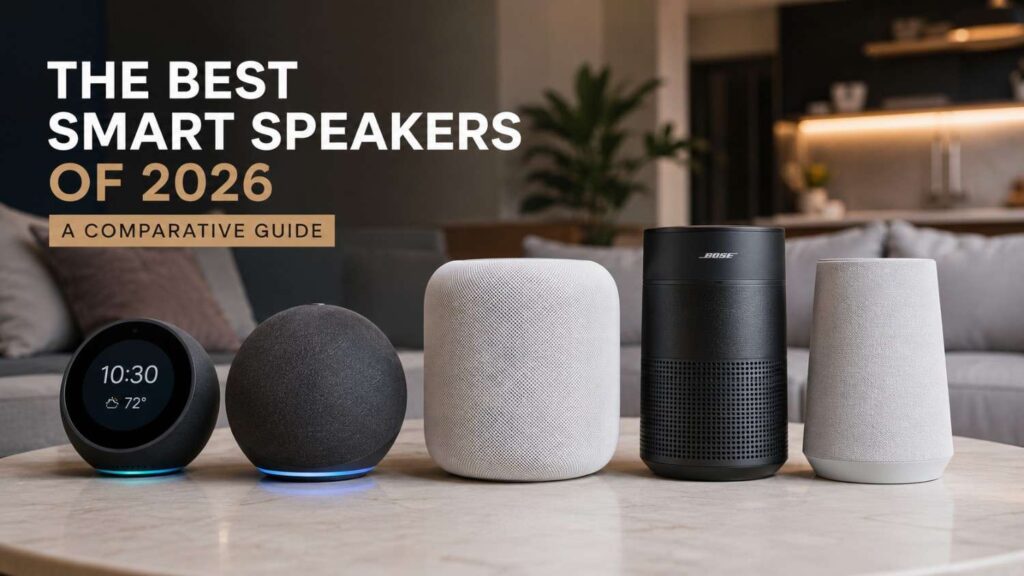
The Best Smart Speakers of 2026: A Comparative Guide
Smart speakers have become much more than devices that play music. They now act as personal assistants, smart home controllers, entertainment hubs, and communication centers. Whether you want to automate your lights, enjoy immersive music, control your TV, or simply ask questions using your voice, today’s smart speakers offer impressive capabilities.
In 2026, competition among Amazon, Apple, Google, Sonos, and Bose continues to drive innovation. AI-powered assistants, better sound engineering, stronger privacy controls, and improved smart home compatibility make this year’s devices more capable than previous generations.
This guide compares the leading smart speakers, explains their strengths and weaknesses, and helps you choose the right model based on your needs.
Modern households increasingly rely on connected technology, and smart speakers have become one of the easiest ways to manage that ecosystem. A single device can answer questions, control connected appliances, stream music, set reminders, manage calendars, make hands-free calls, and even monitor compatible home security devices. As artificial intelligence continues to improve, these speakers are becoming more conversational, understanding natural language instead of relying only on simple voice commands.
Manufacturers are also focusing on long-term software improvements rather than hardware alone. Regular feature updates, smarter AI assistants, stronger security protections, and better support for new smart home standards ensure that today’s devices continue improving long after purchase. This makes investing in a quality smart speaker more valuable than ever.
Whether your priority is premium sound, home automation, privacy, affordability, or seamless ecosystem integration, there is now a smart speaker designed specifically for your needs. This comparative guide explores the latest advancements, compares the leading brands, and explains the features that matter most so you can confidently choose the best smart speaker for your home in 2026.
Why Smart Speakers Are Better Than Ever in 2026
Smart speakers have evolved significantly over the past few years. Improvements in artificial intelligence, wireless connectivity, and home automation standards have made them more reliable and useful in everyday life.
Instead of simply answering questions, today’s speakers understand context, manage routines, and integrate with hundreds of compatible devices.
One of the biggest reasons smart speakers have improved so dramatically is the rapid advancement of artificial intelligence. Modern voice assistants understand natural conversations, remember user preferences, recognize multiple household members, and deliver responses that feel far more intelligent than earlier generations. Rather than acting as simple voice search tools, they now function as digital assistants capable of handling increasingly complex requests while adapting to daily routines.
The widespread adoption of Matter and Thread has also transformed the smart home experience. Previously, users often struggled with compatibility issues between devices from different manufacturers. In 2026, many smart speakers can control products across multiple brands without complicated setup procedures, making connected homes easier to build and maintain. This universal compatibility allows homeowners to mix lighting, security, entertainment, and automation products with greater confidence.
Audio performance has become another major area of improvement. Manufacturers now understand that consumers expect excellent sound quality alongside smart functionality. Larger drivers, improved acoustic engineering, adaptive room calibration, spatial audio, and enhanced bass reproduction allow today’s smart speakers to compete with many traditional wireless speakers. Whether you use them for music, movies, podcasts, or controlling your home, the latest generation offers a far more refined and enjoyable experience than ever before.
AI-Powered Voice Assistants
Modern voice assistants are much smarter than earlier versions. They understand natural conversations, remember preferences, provide personalized recommendations, and perform complex tasks like creating shopping lists, scheduling reminders, and controlling multiple smart devices at once.
Many platforms now use advanced AI models that generate more helpful responses while improving voice recognition accuracy.
Unlike previous generations that required specific command phrases, today’s AI assistants can understand conversational language and maintain context throughout longer interactions. Users can ask follow-up questions naturally without repeating previous information, making conversations feel smoother and more human. This advancement significantly improves the overall user experience, especially for everyday tasks like planning schedules, checking weather forecasts, managing calendars, or searching for information.
Modern AI assistants also learn from user behavior over time. They recognize frequently used commands, personalize music recommendations, adjust routines automatically, and even distinguish between different household members through voice recognition. This personalization allows family members to receive customized reminders, playlists, calendars, and smart home settings based on individual preferences.
Another major improvement is proactive assistance. Instead of waiting for commands, some AI-powered smart speakers can provide helpful suggestions based on routines, upcoming appointments, traffic conditions, weather forecasts, or connected smart home activity. These intelligent capabilities make smart speakers feel less like simple gadgets and more like reliable digital assistants that actively help simplify everyday life.
Better Smart Home Integration
Matter compatibility has simplified smart home setup across different brands. Instead of worrying about device compatibility, many smart speakers now connect seamlessly with lights, thermostats, cameras, plugs, and security systems from multiple manufacturers.
This makes building a smart home much easier for beginners.
One of the biggest frustrations for early smart home users was managing multiple apps and incompatible ecosystems. Matter has largely solved this issue by providing a universal standard that allows supported devices to communicate regardless of manufacturer. As a result, smart speakers can now act as centralized controllers for a wide variety of connected products without requiring complicated configuration.
Beyond compatibility, automation has become much more advanced. Users can create routines that combine multiple devices into a single command, such as locking doors, turning off lights, adjusting thermostats, activating security cameras, and playing relaxing music simultaneously when saying “Good night.” These intelligent automations save time while making connected homes more convenient and efficient.
Improved integration also benefits reliability. Faster communication between devices, local processing for certain commands, and stronger wireless protocols reduce delays and connection failures. Whether controlling lighting, entertainment systems, or home security, today’s smart speakers provide a smoother and more dependable smart home experience that feels genuinely useful rather than experimental.
Improved Audio Performance
Manufacturers now prioritize premium sound alongside smart features. Better drivers, adaptive room tuning, Dolby Atmos support on select models, and enhanced bass performance provide a richer listening experience for music, podcasts, and movies.
Audio engineering has become one of the biggest competitive advantages among premium smart speaker manufacturers. Companies now invest heavily in custom speaker drivers, improved amplifier technology, acoustic chambers, and digital signal processing to deliver fuller, cleaner, and more balanced sound across different music genres. Many flagship models automatically analyze room acoustics and adjust equalization settings to optimize playback based on where the speaker is placed.
Spatial audio and Dolby Atmos support are becoming increasingly common, creating a wider and more immersive listening experience. Instead of producing flat stereo sound, compatible speakers generate greater depth and separation that enhances music, films, and supported streaming content. These technologies help smart speakers compete with dedicated wireless audio systems while maintaining their voice assistant capabilities.
Multi-room audio has also improved significantly. Users can synchronize multiple speakers throughout their homes, allowing music, podcasts, or announcements to play simultaneously across every room with minimal delay. Combined with higher-quality streaming services and advanced wireless connectivity, today’s smart speakers deliver an audio experience that satisfies both casual listeners and serious music enthusiasts.
Key Features to Compare Before Buying
Choosing the best smart speaker involves much more than selecting the newest or most expensive model. While premium devices often include advanced features, the right choice ultimately depends on how you plan to use the speaker every day. Some users prioritize music quality, while others focus on smart home automation, voice assistant capabilities, privacy controls, or compatibility with existing devices. Understanding these priorities before making a purchase will help you select a speaker that provides long-term value instead of paying for features you may never use.
Another important consideration is the ecosystem you already use. If your home is built around Amazon Alexa devices, an Echo speaker will usually offer the smoothest experience. Apple users benefit from seamless integration with HomePod and Siri, while Android users often find Google-powered speakers more convenient because of their close connection with Google Search, Maps, Calendar, and Gmail. Staying within your existing ecosystem typically provides better automation, easier setup, and more consistent performance.
Future compatibility is equally important in 2026. Smart home technology continues to evolve rapidly, so choosing a speaker that supports Matter, Thread, Wi-Fi 6, Bluetooth, and regular software updates helps ensure your investment remains useful for years. Privacy features, AI improvements, multi-room audio, streaming service compatibility, and ongoing manufacturer support should all be considered before making your final decision. Comparing these core features carefully allows you to find a smart speaker that balances performance, convenience, reliability, and overall value.
Sound Quality
If music is your priority, pay attention to speaker size, bass response, stereo imaging, and support for high-quality streaming services. Premium speakers generally offer fuller sound and better clarity.
Sound quality is one of the biggest factors separating entry-level smart speakers from premium models. Larger speaker drivers, dedicated tweeters, improved woofers, and advanced acoustic engineering produce clearer vocals, deeper bass, and better overall balance across different music genres. While compact smart speakers perform well for casual listening, larger premium models provide a much richer and more immersive audio experience that can comfortably fill larger rooms.
Many smart speakers in 2026 also include adaptive room tuning technology. These systems automatically analyze the room’s acoustics and adjust equalization settings based on speaker placement, wall reflections, and furniture layout. This ensures more consistent audio quality regardless of where the speaker is positioned, reducing the need for manual adjustments while maximizing overall performance.
If you frequently stream music, also consider supported audio services and playback quality. Premium models often support higher-quality streaming formats, stereo pairing, spatial audio, Dolby Atmos, and multi-room synchronization. These features create a more engaging listening experience while allowing users to expand their audio system gradually without replacing existing speakers.
Smart Assistant Compatibility
Different ecosystems offer different strengths.
- Alexa excels at smart home automation.
- Google offers excellent search and productivity features.
- Siri integrates seamlessly with Apple devices.
Selecting the ecosystem you already use usually provides the best experience.
The voice assistant built into your smart speaker influences almost every aspect of daily use. Alexa remains one of the strongest choices for smart home automation because it supports an enormous range of compatible devices, routines, and third-party skills. Users who prioritize home automation often appreciate Alexa’s flexibility and extensive ecosystem of connected products.
Google’s smart assistant continues to stand out for its natural language understanding and deep integration with Google’s services. Users can easily access Gmail, Google Calendar, Google Maps, YouTube Music, Google Photos, and Search results through simple voice commands. For Android users or households that rely heavily on Google’s productivity tools, this integration creates a highly convenient everyday experience.
Apple’s Siri is ideal for users already invested in the Apple ecosystem. HomePod works exceptionally well with iPhone, iPad, Apple Watch, Mac, Apple TV, and HomeKit-enabled smart home devices. Features such as AirPlay, Apple Music integration, intercom functionality, and personal requests provide a seamless experience that feels natural for existing Apple customers. Choosing the assistant that best matches your current devices often delivers the smoothest and most reliable overall performance.
| Smart Speaker Ecosystem | Best For | Voice Assistant | Smart Home Strength | Ideal User |
|---|---|---|---|---|
| Amazon Echo | Home automation | Alexa | Excellent device compatibility | Users with multiple smart home devices |
| Apple HomePod | Apple ecosystem | Siri | Strong HomeKit integration | iPhone, iPad, and Mac users |
| Google Nest | Productivity & AI | Google Assistant / Gemini | Excellent Matter support | Android and Google service users |
| Sonos Era | Premium entertainment | Alexa | Good multi-room integration | Music enthusiasts |
| Bose Smart Speaker | High-quality audio | Alexa | Basic smart home support | Users focused on sound quality |
Privacy and Security
Privacy has become a major consideration. Many smart speakers now include microphone mute switches, encrypted communication, customizable voice history settings, and local processing for certain commands, giving users more control over their personal information.
As smart speakers become more intelligent, they also process larger amounts of personal information, making privacy an increasingly important purchasing consideration. Manufacturers now invest heavily in security features that protect user data while giving customers greater transparency and control over how voice recordings and personal information are handled.
Many modern smart speakers include physical microphone mute buttons that completely disable voice listening until manually reactivated. Some manufacturers also process certain commands locally on the device instead of sending every request to cloud servers. Local processing reduces unnecessary data transmission while improving response speed and protecting sensitive information whenever possible.
Users should also review available privacy settings before purchasing. Features such as automatic deletion of voice recordings, customizable data retention periods, encrypted communications, two-factor authentication, and detailed activity controls allow users to manage their information more effectively. Selecting a manufacturer with a strong reputation for privacy and long-term software updates provides additional confidence that your personal data will remain protected as smart home technology continues to evolve.
Comparison of the Best Smart Speakers of 2026
Choosing the best smart speaker often comes down to understanding the strengths of each ecosystem rather than simply comparing specifications. Every major manufacturer focuses on a slightly different audience. Amazon prioritizes home automation and affordability, Apple emphasizes premium sound and ecosystem integration, Google delivers outstanding AI capabilities and productivity features, Sonos targets serious music lovers, while Bose continues to appeal to users who value exceptional audio engineering.
Fortunately, today’s smart speakers have become much more versatile than earlier generations. Nearly all premium models now support voice control, smart home automation, wireless music streaming, multi-room audio, and compatibility with a growing number of connected devices. The introduction of Matter has further reduced compatibility concerns, allowing users greater flexibility when expanding their smart homes regardless of brand preference.
The comparison below highlights some of the leading smart speaker categories in 2026. Rather than declaring a single winner for every situation, it is more helpful to match each speaker to the type of user it serves best. Your preferred ecosystem, listening habits, automation needs, and budget will ultimately determine which device delivers the greatest long-term value.
| Speaker | Best For | Voice Assistant | Audio Quality | Smart Home |
|---|---|---|---|---|
| Amazon Echo | Home automation | Alexa | Excellent | Excellent |
| Apple HomePod | Apple ecosystem | Siri | Outstanding | Very Good |
| Google Nest Speaker | Google services | Google Assistant / Gemini | Excellent | Excellent |
| Sonos Era | Premium music | Alexa | Outstanding | Very Good |
| Bose Smart Speaker | Audio enthusiasts | Alexa | Excellent | Good |
Best Overall
Amazon Echo remains one of the most balanced options thanks to its combination of affordability, strong smart home support, and wide compatibility.
The Amazon Echo continues to earn its position as one of the best overall smart speakers because it successfully balances performance, features, ease of use, and price. Alexa remains one of the most capable voice assistants for home automation, supporting thousands of compatible devices from lighting systems and security cameras to thermostats, door locks, smart plugs, and entertainment systems. This extensive compatibility makes Echo devices an excellent foundation for both new and experienced smart home users.
Recent Echo models also offer impressive improvements in sound quality, faster processing, better voice recognition, and stronger Matter compatibility. Users benefit from reliable multi-room audio, flexible automation routines, shopping assistance, reminders, calendars, and seamless integration with Amazon services without sacrificing compatibility with many third-party platforms.
Perhaps Echo’s greatest advantage is its overall value. Buyers receive an excellent balance of audio performance, smart features, regular software updates, and competitive pricing. For households seeking a versatile smart speaker capable of handling music, automation, communication, and everyday productivity, Amazon Echo remains one of the safest and most practical choices available in 2026.
Best Premium Choice
Apple HomePod stands out with exceptional sound quality and deep integration with Apple products, making it ideal for iPhone, iPad, and Mac users.
For users fully invested in the Apple ecosystem, HomePod delivers one of the most polished smart speaker experiences available today. Setup is remarkably simple, with automatic pairing to iPhones and seamless integration across Apple devices. Features such as AirPlay, Apple Music, HomeKit automation, personal requests, and Apple TV compatibility create an ecosystem that works together with very little manual configuration.
Sound quality is another major strength of HomePod. Advanced acoustic engineering, computational audio, adaptive room sensing, and spatial audio technology allow the speaker to produce exceptionally rich, balanced sound despite its relatively compact size. Vocals remain clear, bass is controlled yet powerful, and the overall listening experience rivals many dedicated premium wireless speakers.
Although HomePod is generally more expensive than many competitors, its combination of premium sound quality, elegant design, excellent build quality, strong privacy protections, and tight Apple integration makes it an outstanding investment for users who already rely heavily on Apple’s ecosystem and services.
Best Value
Google’s smart speakers continue to offer excellent AI capabilities, reliable voice recognition, and competitive pricing, making them a great value for many households.
Google-powered smart speakers provide one of the strongest combinations of intelligence and affordability available in 2026. Their biggest strength lies in Google’s search technology and advanced AI capabilities, allowing users to ask complex questions, receive highly accurate answers, manage calendars, navigate traffic, control smart devices, and interact naturally using conversational voice commands.
Integration with Google’s services further enhances everyday usability. Gmail, Google Calendar, Google Maps, YouTube Music, Google Photos, and other popular applications work together seamlessly, creating a highly productive environment for Android users and households already relying on Google’s ecosystem.
Despite offering advanced AI functionality, Google’s smart speakers remain competitively priced, making them accessible to a wide range of buyers. Strong audio quality, dependable voice recognition, regular software improvements, Matter compatibility, and impressive overall functionality combine to make Google’s latest smart speakers one of the best value options for users seeking intelligent features without paying premium flagship prices..
Choosing the Right Smart Speaker for Your Needs
While all modern smart speakers can answer questions, stream music, and control compatible devices, the best option depends on how you plan to use it. Before buying, think about the ecosystem you’re already invested in, your budget, and the features you use most often. Choosing a speaker without considering these factors can lead to compatibility issues or paying for features you rarely use.
A smart speaker should fit naturally into your daily routine rather than requiring you to change how you use technology. For example, if your household already relies on Amazon Alexa-compatible devices, an Echo speaker will typically provide the smoothest experience. Similarly, Apple users usually benefit most from HomePod because of its seamless integration with iPhones, iPads, Macs, Apple TV, and HomeKit accessories. Google users often appreciate the convenience of Google’s AI-powered speakers because they work closely with Gmail, Google Calendar, Google Maps, and other Google services.
Room size and listening habits should also influence your decision. Smaller speakers work well in bedrooms, offices, or kitchens where voice control is the primary focus. Larger premium speakers are better suited for living rooms or entertainment spaces where sound quality is equally important. Some households also benefit from using multiple smart speakers connected through multi-room audio, allowing synchronized music playback throughout the home.
Long-term value is another important consideration. A speaker that receives regular software updates, supports modern smart home standards such as Matter and Thread, and offers reliable privacy controls is likely to remain useful for many years. By evaluating your daily needs, preferred ecosystem, audio expectations, and future smart home plans, you can choose a smart speaker that delivers excellent performance without unnecessary compromises.
| Buying Factor | Why It Matters | Things to Consider |
|---|---|---|
| Sound Quality | Improves music, movies, and podcasts | Driver size, bass performance, room tuning |
| Smart Home Compatibility | Ensures seamless device control | Matter, Thread, Alexa, Google Home, HomeKit |
| Voice Assistant | Affects daily usability | Alexa, Siri, Google Assistant features |
| Privacy Features | Protects personal information | Microphone mute, local processing, voice history controls |
| Software Updates | Keeps the speaker secure and future-ready | Long-term manufacturer support |
| Budget | Helps balance features and value | Entry-level, mid-range, or premium models |
Best for Music Lovers
If sound quality is your top priority, look for speakers with larger drivers, room-tuning technology, and support for high-quality streaming services. Premium models generally deliver richer bass, clearer vocals, better stereo separation, a wider soundstage, and support for multi-room audio, creating a far more immersive listening experience than entry-level devices.
Today’s premium smart speakers use sophisticated acoustic engineering to optimize playback automatically. Adaptive room calibration measures the surrounding environment and adjusts equalization settings to compensate for wall reflections, furniture placement, and room size. This allows music to sound balanced regardless of where the speaker is placed, while technologies such as Dolby Atmos and spatial audio create greater depth and realism for compatible content.
Streaming service compatibility is equally important. Whether you subscribe to Spotify, Apple Music, Amazon Music, TIDAL, YouTube Music, or Deezer, choosing a speaker that supports your preferred platform ensures seamless playback and higher-quality streaming options. Many premium speakers also support lossless audio and wireless stereo pairing, allowing two speakers to work together as a dedicated stereo system.
For users who spend several hours each day listening to music, podcasts, or audiobooks, investing in a higher-end smart speaker can make a significant difference. Better audio clarity reduces listening fatigue, while stronger bass, improved vocal reproduction, and wider stereo imaging provide a richer entertainment experience that extends well beyond simple voice assistant functionality.
Best for Smart Home Automation
For users building a connected home, compatibility is just as important as audio quality. A good smart speaker should communicate reliably with lights, plugs, thermostats, door locks, security cameras, smart TVs, video doorbells, and many other connected devices without requiring complicated setup procedures or multiple control apps.
Modern smart speakers now function as central control hubs that coordinate numerous smart home devices simultaneously. Instead of controlling each product individually, users can create automation routines that combine several actions into a single voice command. For example, saying “Good Morning” can turn on lights, adjust the thermostat, read the weather forecast, start the coffee maker, and provide your daily calendar summary within seconds.
Matter support has become one of the biggest advantages for smart home users in 2026. This universal standard allows compatible devices from different manufacturers to communicate more effectively, reducing compatibility issues that previously made smart home setup difficult. Whether you purchase products from Amazon, Google, Apple, Samsung, Philips Hue, or other major brands, Matter simplifies device integration and future expansion.
When choosing a smart speaker for automation, consider both your current and future smart home plans. Selecting a platform with broad compatibility, reliable automation features, frequent software updates, and strong security protections provides greater flexibility as your connected home continues to grow.
Best Budget-Friendly Option
Not everyone needs a premium smart speaker packed with advanced audio technology and high-end features. Many affordable models still provide excellent everyday functionality while remaining accessible to first-time buyers, students, families, or anyone looking to add voice control to their home without making a large financial investment.
Budget-friendly smart speakers typically include the most popular features users rely on every day. These include voice commands, music streaming, weather updates, timers, reminders, shopping lists, calendar integration, alarms, hands-free calling, and basic smart home control. Although they may not produce the same powerful sound as premium speakers, they often perform extremely well for casual listening and general household assistance.
Compact entry-level models are particularly well suited for smaller spaces such as bedrooms, kitchens, home offices, or apartments. Their smaller size allows them to fit easily on desks, shelves, or countertops while still providing reliable voice recognition and convenient access to digital assistants. Many households even purchase several affordable speakers instead of investing in a single premium device, creating whole-home voice coverage at a lower overall cost.
Choosing an affordable smart speaker does not necessarily mean sacrificing quality. Many entry-level models receive the same software updates, AI improvements, and smart home features as their more expensive counterparts. For users who prioritize convenience, voice assistance, and basic automation over premium audio performance, a budget-friendly smart speaker offers excellent value and a practical introduction to smart home technology.
Pros and Cons of Smart Speakers
Smart speakers have become one of the most popular smart home devices because they combine entertainment, productivity, communication, and automation into a single compact product. However, like any connected technology, they offer both advantages and potential limitations. Understanding these strengths and weaknesses before purchasing helps ensure that your expectations match the capabilities of the device you choose.
For many households, the convenience of hands-free voice control quickly becomes part of everyday life. Tasks such as setting reminders, checking the weather, controlling lights, playing music, managing shopping lists, and operating smart home devices can all be completed within seconds using simple voice commands. As artificial intelligence continues to improve, smart speakers become increasingly helpful by understanding more natural conversations and personalizing responses based on user preferences.
Despite these benefits, smart speakers are not perfect. Their performance depends heavily on internet connectivity, ecosystem compatibility, and the quality of the voice assistant being used. Some advanced features may require subscriptions, while certain smart home products perform better within specific ecosystems than others. Privacy concerns also remain an important consideration because these devices continuously listen for wake words before processing commands.
By carefully weighing both the advantages and potential drawbacks, buyers can make a more informed decision. Selecting the right ecosystem, understanding privacy settings, and purchasing a speaker that matches your actual needs rather than simply choosing the most expensive model often leads to greater long-term satisfaction.
Best for Music Lovers
If sound quality is your top priority, look for speakers with larger drivers, room-tuning technology, and support for high-quality streaming services. Premium models generally deliver richer bass, clearer vocals, better stereo separation, a wider soundstage, and support for multi-room audio. These features create a far more immersive listening experience, making premium smart speakers ideal for users who spend a significant amount of time enjoying music, podcasts, or audiobooks.
Modern smart speakers also include intelligent audio processing that automatically adjusts playback based on the room’s acoustics. Built-in microphones analyze reflections, room size, and speaker placement, allowing the system to optimize equalization without requiring manual adjustments. This means you receive balanced sound whether the speaker is placed on a bookshelf, countertop, or entertainment center. Some premium models even support Dolby Atmos and spatial audio, creating a more realistic listening environment for compatible music and movies.
Streaming service compatibility is another important factor. Most leading smart speakers support popular platforms such as Spotify, Apple Music, Amazon Music, YouTube Music, and Deezer through native voice commands. Some models also support lossless audio and high-resolution streaming, offering improved clarity for listeners who value audio fidelity. If you already subscribe to a particular music service, selecting a speaker that integrates seamlessly with that platform will make daily use much more convenient.
Investing in a premium smart speaker is worthwhile if music is your primary use case. Better hardware, stronger amplification, improved bass response, and advanced room optimization technologies deliver a noticeable improvement over entry-level models. Although these speakers cost more, they often replace traditional Bluetooth speakers while adding powerful voice assistant capabilities, making them an excellent long-term investment for entertainment.
Best for Smart Home Automation
For users building a connected home, compatibility is just as important as audio quality. A good smart speaker should work smoothly with smart lights, plugs, thermostats, security cameras, video doorbells, smart locks, TVs, robotic vacuums, and many other connected devices. The speaker effectively becomes the central hub that manages and coordinates your entire smart home ecosystem through simple voice commands or automated routines.
One of the biggest advantages of today’s smart speakers is their ability to automate multiple devices simultaneously. Instead of controlling each product individually, users can create customized routines that perform several actions with a single command. For example, saying “Good Night” can turn off lights, lock doors, lower the thermostat, arm security cameras, and play relaxing sleep sounds within seconds. These automations save time while making everyday routines much more convenient.
Matter support has become a major improvement for smart home users in 2026. This universal connectivity standard allows products from different manufacturers to work together more reliably, reducing compatibility issues that previously complicated smart home setups. Whether your devices come from Amazon, Google, Apple, Samsung, Philips Hue, TP-Link, or other manufacturers, Matter simplifies integration and makes expanding your smart home much easier.
Before purchasing a smart speaker for automation, consider both your current devices and your future plans. Choosing a platform with broad compatibility, reliable software updates, strong privacy protections, and extensive third-party support ensures that your investment remains useful as your smart home grows over time. A well-chosen smart speaker becomes the control center for a safer, more efficient, and more connected living environment.
Best Budget-Friendly Option
Not everyone needs a premium smart speaker with advanced acoustic engineering and flagship features. Budget-friendly smart speakers continue to improve each year and now offer impressive functionality at a much lower price. For many users, these affordable models provide everything needed for everyday voice assistance, music streaming, and basic smart home control without requiring a large financial investment.
Entry-level smart speakers typically include the core features that most households use daily. These include voice commands, timers, alarms, reminders, shopping lists, weather updates, news briefings, calendar integration, music streaming, and control of compatible smart home devices. While their speakers may not deliver the same powerful bass or room-filling sound as premium models, they perform very well for casual listening and voice interactions.
Compact smart speakers are especially suitable for bedrooms, kitchens, offices, dorm rooms, or apartments where space is limited. Their small footprint allows them to fit easily on desks, countertops, or shelves while still providing reliable voice recognition and fast access to digital assistants. Many households choose to purchase multiple affordable speakers instead of a single premium device, allowing voice control throughout the home at a lower overall cost.
Budget-friendly does not necessarily mean outdated or limited. Many entry-level speakers receive the same software updates, AI improvements, and smart home integrations as higher-priced models. They often support modern connectivity standards, multiple streaming services, and expanding smart home ecosystems. For first-time buyers or users who prioritize convenience over premium audio quality, affordable smart speakers represent one of the best values available in today’s smart home market.
You’re right—those sections were missing. Here’s the continuation following the same structure and expansion style.
Quick Answer About The Best Smart Speakers of 2026
If you’re looking for the best smart speakers of 2026, your ideal choice depends on your preferred smart home ecosystem, audio expectations, and budget. Amazon Echo devices remain excellent for Alexa users, Apple’s HomePod continues to deliver premium sound for Apple households, while Google’s latest smart speakers provide seamless integration with Google services and AI-powered assistance. Features like Matter support, improved voice recognition, multi-room audio, and AI assistants have made today’s smart speakers more capable than ever. Choosing the right model means balancing sound quality, smart features, compatibility, and value.
Smart speakers have evolved into complete smart home hubs rather than simple voice-controlled music players. They can control lights, security cameras, thermostats, televisions, door locks, and hundreds of other compatible devices from a single voice command. Whether you are building your first smart home or upgrading an existing setup, selecting a speaker that matches your preferred ecosystem will provide the smoothest experience. Compatibility with Alexa, Google Assistant, Siri, and Matter-supported devices has become one of the biggest deciding factors for buyers in 2026.
Audio quality has also improved dramatically across nearly every category. Modern smart speakers feature adaptive sound tuning, larger drivers, spatial audio support, enhanced bass performance, and intelligent room calibration that automatically adjusts sound based on placement. These improvements allow users to enjoy richer music playback, clearer podcast listening, and more immersive movie audio without needing expensive home theater systems.
When comparing the best smart speakers of 2026, consider more than just voice assistants. Look at privacy controls, software updates, streaming service support, smart home compatibility, multi-room synchronization, and long-term reliability. The best smart speaker is the one that fits naturally into your daily routine while offering dependable performance, excellent sound quality, and seamless integration with the devices you already own.
Frequently Asked Questions
Frequently Asked Questions (FAQs) are an important part of any fitness guide because they provide quick, clear answers to the most common doubts people have. Instead of going through long explanations, readers can use FAQs to understand key concepts in a simple and direct way.
In fitness, people often struggle with similar concerns such as workout routines, diet plans, progress timelines, and motivation. FAQs help simplify these topics and make it easier to apply practical steps in real life.
They also serve as a quick summary of the most important points covered in a guide. By reviewing FAQs, readers can reinforce their understanding and make better decisions about their fitness journey.
Which smart speaker is best in 2026?
There is no single smart speaker that is best for every user because the ideal choice depends on your ecosystem, listening preferences, smart home setup, and budget. Amazon Echo devices remain one of the strongest overall options for users who want extensive smart home automation, broad device compatibility, and excellent value. Apple HomePod is an outstanding choice for people already invested in the Apple ecosystem, while Google Nest speakers continue to provide excellent AI capabilities and seamless integration with Google services.
Sound quality should also influence your decision. Premium speakers typically offer richer bass, clearer vocals, adaptive room tuning, and better stereo performance than entry-level models. If music is your primary focus, investing in a higher-end speaker may provide a noticeably better listening experience than choosing a budget model.
Another important consideration is compatibility with your existing devices. Choosing a speaker that naturally works with your smartphone, streaming services, and smart home products creates a smoother and more enjoyable experience. Features such as Matter support, multi-room audio, and AI-powered voice assistants have also become important factors when comparing the best smart speakers of 2026.
Instead of focusing only on specifications or price, evaluate how the speaker will fit into your daily routine. The best smart speaker is the one that offers the right balance of audio quality, intelligent features, privacy controls, ecosystem compatibility, and long-term value for your specific needs.
Are smart speakers worth buying?
For many households, smart speakers are absolutely worth buying because they combine multiple functions into one convenient device. They provide hands-free voice assistance, high-quality music streaming, smart home control, reminders, communication, and quick access to information throughout the day. Instead of switching between different apps or devices, users can perform many everyday tasks using simple voice commands.
One of the biggest benefits is convenience. Smart speakers help simplify routines by controlling lights, adjusting thermostats, managing shopping lists, setting alarms, answering questions, playing music, and providing calendar updates. Families can also use them for household announcements, timers while cooking, educational assistance, and entertainment for children and adults alike.
Their value increases even further when paired with smart home devices. Connected lights, cameras, plugs, locks, and appliances can all be controlled through a central voice assistant, creating automated routines that improve both comfort and efficiency. As AI assistants become more advanced, smart speakers continue to gain new capabilities through software updates without requiring new hardware.
Whether a smart speaker is worth purchasing depends on how you intend to use it. For users who regularly stream music, own connected devices, or appreciate hands-free convenience, a smart speaker can become one of the most frequently used pieces of technology in the home.
Which smart speaker has the best sound quality?
Sound quality varies significantly between different smart speakers, and the best option depends on both your listening preferences and budget. Premium models generally deliver superior performance thanks to larger drivers, dedicated woofers and tweeters, advanced amplification, and intelligent room calibration technologies. These features create fuller bass, clearer vocals, wider stereo imaging, and a more immersive listening experience.
Apple HomePod and Sonos Era models are frequently recognized for their exceptional audio performance. They automatically analyze room acoustics and adjust sound output to deliver balanced playback regardless of speaker placement. These devices also support high-quality music streaming services and advanced audio technologies that enhance both music and movie playback.
Amazon Echo and Google Nest speakers also provide impressive sound quality, particularly in their premium models. While they may prioritize smart home integration alongside entertainment, many users find their audio performance more than sufficient for everyday music listening, podcasts, and voice interactions. Entry-level speakers remain suitable for smaller rooms where convenience is more important than powerful bass or high-volume playback.
The best smart speaker for sound quality ultimately depends on your expectations. If you are an audiophile or spend hours listening to music every day, investing in a premium model is worthwhile. Casual listeners, however, may find that mid-range speakers provide an excellent balance between audio performance, smart features, and affordability.
Can smart speakers control smart home devices?
Yes. One of the biggest advantages of modern smart speakers is their ability to serve as central controllers for smart home devices. They allow users to manage compatible products through simple voice commands, mobile apps, or automated routines. Instead of manually operating each device, homeowners can control multiple systems from a single platform.
Most leading smart speakers support a wide variety of connected devices, including smart lights, thermostats, plugs, door locks, security cameras, video doorbells, televisions, robotic vacuum cleaners, air purifiers, and other household appliances. Voice commands such as turning lights on, adjusting room temperature, locking doors, or starting a cleaning routine can all be completed within seconds.
Modern interoperability standards like Matter have greatly simplified smart home compatibility. Rather than limiting users to products from one manufacturer, many devices now communicate across different ecosystems more effectively. This flexibility allows homeowners to build connected environments using products from multiple brands while managing everything through a single smart speaker.
As smart home technology continues to expand, smart speakers are becoming increasingly important as the central hub for automation. Their ability to coordinate multiple devices, create personalized routines, and simplify everyday household management makes them one of the most valuable components of a connected home.
Do smart speakers protect user privacy?
Privacy has become a major focus for smart speaker manufacturers, and today’s devices include numerous features designed to give users greater control over their personal information. Most models offer physical microphone mute buttons, encrypted communication, customizable voice history settings, and options to review or delete stored recordings.
Many manufacturers are also introducing local voice processing, allowing certain commands to be handled directly on the device instead of being sent to cloud servers. This approach reduces latency while minimizing the amount of personal data transmitted online. Local processing is becoming increasingly common for routine tasks such as controlling lights, setting timers, or adjusting playback.
Users should still take an active role in protecting their privacy. Regularly reviewing privacy settings, deleting unnecessary voice recordings, limiting app permissions, and enabling available security features all contribute to a safer smart home experience. Understanding how each manufacturer handles data collection is also an important part of choosing the right smart speaker.
While no connected device can guarantee complete privacy, today’s smart speakers offer significantly stronger security and transparency than earlier generations. As privacy regulations continue to evolve, manufacturers are expected to provide even more user control over personal data in future devices.
Do I need Wi-Fi to use a smart speaker?
Yes, most smart speaker features require an active Wi-Fi connection because voice assistants rely on internet access to process requests, retrieve information, stream content, and communicate with cloud-based services. Without Wi-Fi, many core functions such as asking questions, controlling connected smart home devices remotely, or accessing streaming services will not operate normally.
However, many smart speakers still provide limited functionality without internet access. Bluetooth connectivity allows users to stream music directly from smartphones, tablets, or computers without using Wi-Fi. Basic speaker controls such as volume adjustment and playback may also continue to function depending on the specific model.
Some manufacturers are gradually expanding offline capabilities by introducing local processing for frequently used commands. Tasks such as controlling certain smart home devices, setting timers, or adjusting speaker settings may work without requiring cloud communication. These improvements help reduce dependence on internet connectivity while improving response times.
For the full smart speaker experience, including AI assistance, streaming services, smart home automation, and cloud-based features, a reliable Wi-Fi connection remains essential. Choosing a stable home network ensures the best overall performance and allows users to take full advantage of everything modern smart speakers have to offer.
Conclusion
The Best Smart Speakers of 2026 represent a significant step forward in how people interact with technology at home. No longer limited to playing music or answering simple questions, today’s smart speakers serve as intelligent assistants that support entertainment, productivity, communication, and smart home automation. Improvements in artificial intelligence, Matter compatibility, audio engineering, and privacy controls have made these devices more capable, reliable, and useful than ever before.
Choosing the right smart speaker depends on understanding your own priorities rather than simply selecting the most expensive model. Music enthusiasts may prioritize premium sound quality, while smart home users may focus on automation features and ecosystem compatibility. Others may simply want an affordable device that provides reliable voice assistance and everyday convenience. Evaluating factors such as supported voice assistants, privacy protections, streaming services, software updates, and long-term compatibility will help you make a smarter purchasing decision.
As artificial intelligence continues to evolve, smart speakers are expected to become even more conversational, proactive, and personalized. They will increasingly coordinate connected devices, simplify household management, provide intelligent recommendations, and support more natural interactions while placing greater emphasis on privacy and local processing. These innovations will further strengthen their role as the central hub of modern connected homes.
Ultimately, investing in the right smart speaker is about improving your everyday experience rather than simply adding another gadget to your home. By selecting a model that aligns with your ecosystem, lifestyle, and future smart home plans, you can enjoy a device that delivers lasting value, adapts to new technologies, and continues to enhance convenience, entertainment, and productivity for years to come.