
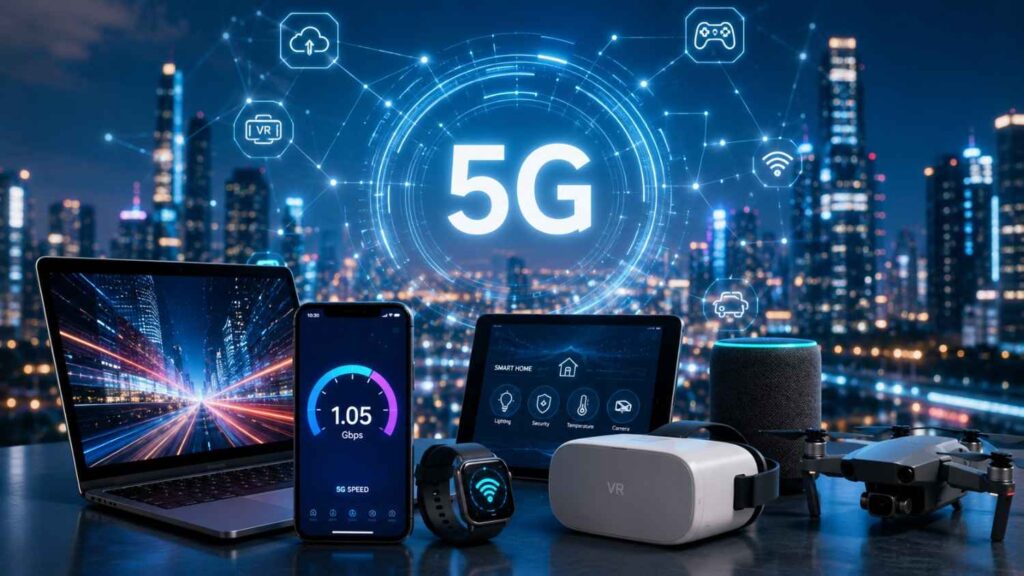
How 5G is Enhancing Consumer Tech Devices
5G is often promoted as a faster replacement for 4G, but that description captures only one part of its influence. The technology is changing how consumer products connect to networks, exchange information, access cloud services, and remain functional away from fixed broadband. Smartphones provide the most visible example, yet 5G is also influencing tablets, smartwatches, security cameras, gaming platforms, home internet routers, extended-reality systems, and emerging connected products.
The most important improvements come from a combination of higher network capacity, more flexible spectrum use, stronger upload performance, lower potential latency, and support for different device categories. Together, these capabilities allow manufacturers and service providers to design experiences that would be difficult to deliver consistently through earlier mobile networks.
The transition is already well advanced. The June 2026 Ericsson Mobility Report stated that worldwide 5G subscriptions had passed three billion and that 5G networks were carrying approximately half of global mobile data traffic. It also reported continued expansion in 5G Fixed Wireless Access and commercial services using differentiated network capabilities.
Those figures show that 5G is moving beyond early adoption. However, broader availability does not mean every device or user receives the same benefits. Performance varies considerably between countries, carriers, frequency bands, neighbourhoods, buildings, mobile plans, and device models.
Understanding how 5G is enhancing consumer tech devices therefore requires more than comparing advertised maximum speeds. Consumers need to consider how the network affects responsiveness, reliability, mobility, cloud access, battery behaviour, and the ability to support several connected products at the same time.
What Makes 5G Different From 4G?
The difference between 4G and 5G is not simply that one network is newer or capable of downloading files more quickly. Fifth-generation mobile technology was developed around a wider set of performance goals, including enhanced mobile broadband, low-latency communication, improved network efficiency, and support for large numbers of connected devices.
The International Telecommunication Union’s IMT-2020 framework identifies several performance areas for 5G systems. These include peak data rates, user-experienced speeds, connection density, mobility, spectral efficiency, energy efficiency, traffic capacity, and latency. Taken together, these requirements create a technical foundation that can support more varied services than a traditional smartphone-focused mobile network.
Another major difference is flexibility. 5G can operate across low-, mid-, and high-frequency spectrum. Each range provides a different balance of coverage, penetration, capacity, and speed. Low-band networks can reach wider areas, while mid-band spectrum often provides a stronger balance between coverage and performance. High-band millimetre-wave systems can support substantial capacity over shorter distances.
5G networks can also evolve toward Standalone architecture, which uses a dedicated 5G core rather than depending partly on existing 4G infrastructure. This can support features such as more advanced network slicing, improved service management, and closer integration with edge computing.
For consumers, these technical changes matter because they influence how reliably devices perform during demanding activities. The practical benefit may appear as quicker downloads, better uploads, smoother video, more responsive cloud tools, stronger service in crowded areas, or new products designed around continuous mobile connectivity.
Higher Speed and Network Capacity
Speed is the most marketable feature of 5G, but capacity is often the more important improvement in real consumer environments. A network may produce an impressive speed-test result when few people are connected, yet perform poorly when hundreds or thousands of users compete for the same resources. Greater capacity helps a network manage more simultaneous demand without slowing every device to the same degree.
The ITU’s IMT-2020 performance requirements include theoretical peak data rates of 20 Gbit/s for downlink and 10 Gbit/s for uplink. These figures represent technical evaluation targets under controlled conditions. They are not normal speeds that an individual phone, tablet, or router should expect during everyday use.
Actual performance depends on the spectrum deployed, the width of available channels, signal quality, carrier configuration, tower load, backhaul capacity, device modem, and the server supplying the content. A premium 5G phone cannot overcome a congested tower or slow application server.
Where deployment is strong, greater network capacity can improve high-resolution streaming, app downloads, video uploads, cloud backups, and mobile hotspot use. It can also make performance more consistent in airports, stadiums, transport hubs, shopping districts, and other crowded locations where older networks may become overloaded.
Lower Potential Latency
Latency measures the delay between a request leaving a device and a response returning. It affects how responsive an application feels, particularly when information must travel repeatedly between a consumer device and a remote service. Lower latency can improve interactive activities such as multiplayer gaming, video calling, remote control, cloud applications, and augmented-reality experiences.
The IMT-2020 framework includes a radio-interface latency target of approximately four milliseconds for enhanced mobile broadband and one millisecond for certain ultra-reliable low-latency scenarios. These figures apply to specific test conditions and should not be confused with total internet latency experienced by a consumer.
An actual request must pass through the device, radio network, mobile core, internet route, application infrastructure, and remote server before the result returns. A distant or overloaded server can therefore produce noticeable delay even when the radio connection itself performs well.
Edge computing can reduce part of this journey by placing application resources closer to the user. Instead of sending every request to a distant central data centre, an operator or service provider can process suitable workloads at a nearby edge location.
For consumers, the benefit is not simply a lower number on a technical chart. It is a more immediate response when an application depends on continuous communication with the network.
| 5G capability | Technical foundation | Potential consumer benefit | Important limitation |
|---|---|---|---|
| Higher throughput | Wider channels and efficient spectrum use | Faster downloads, uploads, and high-resolution media | Peak rates are not everyday speeds |
| Lower radio latency | IMT-2020 latency requirements | More responsive gaming and cloud tools | Total latency also depends on routing and servers |
| Greater connection density | Support for large numbers of devices | Better performance in connected environments | Network design and spectrum remain critical |
| Edge computing | 3GPP 5G Core enhancements | Faster access to nearby applications | Edge services must be deployed by providers |
| RedCap | Reduced-complexity 5G specification | Smaller and potentially more efficient devices | Device and network support are required |
| Network slicing | Logical networks with defined characteristics | More consistent service for selected applications | Availability varies by operator and market |
How 5G Improves Smartphones and Tablets
Smartphones and tablets remain the primary way most consumers experience 5G. These devices combine powerful processors, high-resolution displays, advanced cameras, cloud applications, and large storage requirements, making them well suited to benefit from stronger mobile connectivity.
The clearest improvement appears when users perform data-heavy activities away from reliable Wi-Fi. Examples include downloading a large application, uploading high-resolution video, joining a video conference, sharing a mobile hotspot, synchronising cloud storage, or streaming high-quality media while travelling.
As the range of 5G consumer electronics continues to expand, manufacturers are increasingly optimizing smartphones, tablets, and connected devices to take advantage of higher-capacity mobile networks and more responsive cloud-based services.
5G can also improve the consistency of these activities in busy areas. A device does not need the highest possible speed at every moment. It needs enough available capacity to maintain acceptable performance while other users are connected to the same network.
However, the network is only one part of the experience. The phone or tablet must support the carrier’s frequency bands, and the user’s plan must allow access to the relevant 5G services. The device modem, antenna design, thermal management, operating system, and battery settings also influence performance.
Another important change is that mobile operating systems are increasingly designed to treat 5G as a capable alternative to Wi-Fi for selected tasks. Features such as automatic cloud backup, high-quality video calling, larger software downloads, and enhanced media streaming may become available when the device detects a suitable 5G connection.
The result is greater freedom. Consumers can complete more demanding work without depending entirely on public Wi-Fi, although data allowances, signal quality, security, and battery use still require attention.
Smoother Streaming, Downloads, and Uploads
High-resolution video places sustained demand on a network. It requires enough bandwidth to deliver data continuously and enough capacity to avoid severe buffering when many users are active. A strong 5G connection can make 4K streaming, live broadcasts, video calls, and large media downloads more practical on mobile devices.
Downloads receive most of the attention, but uploads are equally important for modern consumer behaviour. People now upload large photo libraries, back up video to cloud storage, livestream events, send high-resolution files, and participate in two-way video communication. Creators and remote workers may depend on upload quality as much as download speed.
Apple’s 5G settings provide a useful example of how manufacturers are adapting device behaviour. The “Allow More Data on 5G” setting can enable higher-quality FaceTime, high-definition video, operating-system updates, and automatic iCloud backup over mobile data. These options demonstrate that the value of 5G lies partly in allowing tasks previously reserved for Wi-Fi.
Faster connectivity does not remove every limitation. A video service may reduce quality during congestion, and a limited data plan can be consumed quickly by high-resolution content. Device temperature, application restrictions, and background activity may also affect performance.
Consumers should therefore balance quality settings with their plan allowance, battery needs, and actual network conditions.
More Responsive Cloud Apps and Gaming
Cloud applications rely on continuous communication between the consumer device and remote computing infrastructure. Instead of processing every task locally, the device sends information to a server, waits for processing, and receives the result. This approach can support advanced AI tools, cloud editing, virtual desktops, online collaboration, and games that require more computing power than the device can provide.
Cloud gaming is one of the clearest examples. A cloud platform renders the game on a remote server, streams the video to the player, and receives controller inputs in real time. The experience depends on bandwidth, latency, jitter, packet loss, server distance, and network stability.
A well-deployed 5G connection can reduce delay and provide enough capacity for high-quality streaming. Edge computing may improve performance further by placing gaming or application infrastructure closer to the user. This shortens part of the network route and can make controls feel more immediate.
However, the presence of a 5G signal does not guarantee excellent gaming. An unstable connection with changing signal strength may produce interruptions, while a strong fibre or Wi-Fi connection may remain more consistent.
Consumers should judge performance through real use rather than advertised peak speeds. Stability and latency variation often matter more to interactive applications than a single high download result.
How 5G Expands Wearables, XR, and Connected Devices
The influence of 5G extends beyond devices with large screens and powerful processors. Wearables, connected cameras, sensors, extended-reality products, health devices, and portable equipment can also benefit from direct mobile connectivity. However, these products have different technical requirements from smartphones.
A smartwatch, for example, may need reliable messaging, location updates, emergency communication, and occasional media access. It usually does not need the same peak data rate as a premium phone. A security camera may require stronger upload capacity but limited interactive performance. An augmented-reality headset may need low delay, continuous data exchange, and access to remote processing.
Using full smartphone-class 5G hardware in every product would increase cost, complexity, physical size, heat, and power consumption. For that reason, the 5G ecosystem includes technologies designed for different performance levels.
Reduced Capability New Radio, commonly known as RedCap or NR-Light, addresses devices that require more capability than basic low-power sensors but less than flagship smartphones. Edge computing can also allow smaller devices to move selected processing tasks away from the local hardware.
These developments make 5G a broader device platform rather than a single type of mobile connection. Manufacturers can choose an approach based on the product’s data requirements, battery capacity, mobility, size, and expected use.
The most successful implementations will not place 5G in every product without justification. They will use it where direct, dependable mobile connectivity creates a meaningful advantage over Wi-Fi, Bluetooth, Thread, Zigbee, LTE-M, or other established technologies.
| Device Category | Primary 5G Advantage | Common Consumer Use Cases | Key Consideration |
|---|---|---|---|
| Smartphones | Faster downloads and improved responsiveness | Streaming, video calls, cloud apps | Coverage and supported bands |
| Tablets | Better mobile productivity | Remote work, online learning, media consumption | Data plan availability |
| Smart Wearables | Efficient always-on connectivity | Fitness tracking, health monitoring | Battery optimization |
| XR Devices | Lower latency for immersive experiences | AR navigation, VR entertainment | Network quality and edge computing |
| Connected Cameras | Faster upload performance | Live streaming, security monitoring | Stable uplink connection |
| Home Routers (FWA) | Broadband without wired infrastructure | Home internet, remote work | Signal strength and tower proximity |
RedCap Makes 5G More Practical for Smaller Devices
3GPP Release 17 introduced Reduced Capability New Radio to support products that do not require the full complexity or performance of standard 5G smartphones. RedCap reduces technical requirements by using narrower bandwidth, fewer antenna branches, and simplified device capabilities.
This creates a middle category between high-performance 5G equipment and low-throughput Internet of Things technologies. It may be suitable for smartwatches, industrial wearables, connected cameras, monitoring devices, health equipment, and sensors that require moderate data rates or more responsive communication.
The potential consumer benefit is a better balance between connectivity and device design. A manufacturer may be able to build a smaller or less expensive product than would be possible with a full smartphone modem. Simplified hardware may also support improved energy efficiency, although RedCap alone cannot guarantee long battery life.
Battery performance still depends on the display, processor, operating system, sensors, signal conditions, application behaviour, and frequency of data transmission. A wearable constantly uploading information in weak coverage may consume more power than one sending occasional updates in a strong signal area.
RedCap adoption also requires support from both devices and mobile networks. Consumers should therefore avoid assuming that every future wearable will automatically use the technology. Availability will depend on carrier deployment, regional spectrum, manufacturer decisions, certification, and commercial demand.
Extended Reality Can Use Cloud Processing
Augmented-reality and virtual-reality devices face difficult design trade-offs. They need sufficient computing power to produce responsive visuals, yet they must remain light enough to wear comfortably. More local processing can increase weight, battery consumption, heat generation, and cost.
Cloud and edge processing offer another approach. A headset can capture movement or environmental information, send part of that data to a nearby computing platform, and receive processed content in return. This can reduce some of the hardware burden inside the wearable device.
5G may support this model through higher capacity and lower potential latency. The network can carry high-resolution visual information and respond quickly enough for selected interactive experiences. Edge computing is especially important because a distant central cloud may add too much delay for comfortable real-time use.
Even small delays can affect an extended-reality experience. Poor responsiveness may make objects feel disconnected from the user’s movement and can contribute to discomfort. Stable performance is therefore more important than an occasional peak speed.
The technology does not remove the need for local processing. Safety functions, tracking, essential controls, and some rendering tasks may still need to remain on the device.
As networks and hardware mature, hybrid designs may become more common, with processing divided between the headset, a nearby phone, an edge platform, and the wider cloud.
Connected Cameras Gain Better Upload Options
Connected cameras depend heavily on uplink performance because their main purpose is often to send footage away from the device. Security cameras, dash cameras, body cameras, drones, portable broadcasting equipment, and event-streaming systems may all need to transmit high-resolution video in real time.
A strong 5G connection can provide greater upload capacity than many earlier mobile networks, particularly where suitable mid-band or high-band spectrum is available. This may allow cameras to operate in temporary locations, vehicles, construction sites, outdoor events, or remote areas where fixed broadband is unavailable.
The benefit is not limited to picture quality. Faster uploads can support quicker cloud backup, real-time monitoring, remote review, and automated video analysis. Edge computing may also allow footage to be analysed closer to the camera, reducing the need to send every frame to a distant data centre.
However, continuous video transmission consumes substantial data and power. A battery-operated camera may not be able to stream at full quality all day without careful optimisation. Mobile plans may also include data limits, traffic-management rules, or restrictions on permanent surveillance use.
Not every smart-home camera needs a direct 5G connection. Products already located near stable home Wi-Fi may gain little from adding cellular hardware. 5G is most valuable when mobility, difficult installation, backup connectivity, or remote deployment creates a genuine need.
Related Articles
How 5G Is Changing Home Connectivity
5G is influencing consumer technology inside the home as well as on mobile devices. Fixed Wireless Access, usually shortened to FWA, uses a cellular network to connect a household or small business to the internet. A gateway receives the 5G signal and then distributes connectivity through Wi-Fi or Ethernet.
This approach can replace or supplement a traditional wired connection. It is particularly relevant in areas where fibre, cable, or modern copper infrastructure is unavailable, expensive to deploy, or slow to install. Instead of extending a physical line to every property, a provider can use nearby mobile infrastructure to deliver broadband service.
Broader 5G connectivity trends also show that improvements in mobile infrastructure are benefiting both everyday consumers and organizations that rely on dependable wireless connectivity for modern digital services.
The quality of 5G home internet can vary significantly by address. A property with clear access to a suitable mid-band tower may receive strong performance, while another building in the same neighbourhood may experience weaker service because of distance, terrain, walls, windows, vegetation, or interference.
Indoor equipment also matters. The gateway must be positioned where it can receive a strong cellular signal, and its Wi-Fi system must distribute that connection effectively throughout the property. Poor router placement can create indoor dead zones even when the incoming 5G connection is fast.
For consumers, 5G FWA increases competition and choice. It may provide a faster installation process, a backup connection, or a practical alternative to an underperforming wired service.
However, it should be evaluated as a location-specific broadband product rather than assumed to provide the same result in every home.
Fixed Wireless Access Offers Another Broadband Option
The GSMA describes Fixed Wireless Access as an alternative to the traditional last-mile wireline connection. Instead of relying on a cable entering the property, the customer receives broadband through a nearby mobile network and a dedicated gateway.
This model can reduce the time and cost required to connect some locations. A household may be able to install a gateway without waiting for extensive construction, trenching, or new wiring. Providers can also reach areas where building a full fibre network may not yet be commercially practical.
The June 2026 Ericsson Mobility Report stated that approximately 71% of FWA service providers offered the service over 5G. This indicates that 5G-based home internet has moved beyond a small experimental market and become an important broadband delivery method.
Performance still depends on network resources. A provider must manage household traffic alongside smartphone, business, and other mobile demand. Some plans may use speed tiers, data allowances, traffic-management policies, or location restrictions to maintain service quality.
Before subscribing, consumers should check expected speeds, contract terms, equipment costs, data policies, and cancellation conditions. They should also confirm whether the service can be tested at their exact address.
A trial period is valuable because building materials and local radio conditions may create results that a general coverage map cannot predict accurately.
Connected Homes Need Capacity, Not Just Peak Speed
A modern connected home may include several phones, laptops, tablets, televisions, speakers, cameras, appliances, gaming systems, smart-home hubs, and work devices. These products do not all need extreme speed, but they compete for the same broadband and Wi-Fi resources.
Capacity becomes important when several demanding activities happen at once. One person may join a video meeting while another streams high-resolution content, a game downloads an update, security cameras upload footage, and cloud backups run in the background.
A strong 5G home connection can support this combined demand, but the mobile link is only one part of the system. The gateway’s Wi-Fi standard, antenna design, channel selection, placement, and mesh capabilities determine how effectively that capacity reaches devices around the property.
An old or poorly positioned router may create slow rooms even when the 5G gateway receives an excellent external signal. Consumers should therefore separate incoming broadband performance from internal Wi-Fi performance when troubleshooting.
Many smart-home products use very little data. Sensors, locks, thermostats, and lights usually need reliability more than speed. Televisions, gaming systems, computers, and cameras are more likely to create sustained traffic.
The goal is not to give every connected object gigabit performance. It is to ensure the entire household continues functioning smoothly when several devices communicate at the same time.
Real Benefits and Important 5G Limitations
5G can deliver noticeable improvements, but its performance is shaped by physical, technical, and commercial conditions. Coverage maps and status icons provide only a simplified view of a much more complex system.
A phone may display a 5G symbol while connected to low-band spectrum that prioritises coverage rather than maximum speed. Another device may access mid-band spectrum and achieve a much stronger balance of speed and capacity. In limited locations, millimetre-wave coverage may provide extremely high throughput but struggle to reach through walls or around obstacles.
Network architecture also matters. Some 5G deployments rely partly on existing 4G infrastructure, while Standalone systems use a dedicated 5G core. Consumers may not always see which architecture is active, yet it can influence access to more advanced capabilities.
Device design creates another variable. Different modems, antennas, software settings, and thermal limits can produce different results on the same network. A budget phone may not support every band available from the carrier, while an imported device may lack important regional compatibility.
Data plans can also restrict the experience through speed limits, hotspot policies, deprioritisation, roaming conditions, or high-speed data allowances.
The practical lesson is that 5G should be judged as a complete service involving the network, location, plan, device, and application. Marketing language often isolates one impressive capability, but consumers experience all these factors together.
Understanding the limitations makes it easier to identify where 5G provides real value and where an upgrade may produce little noticeable change.
| Performance Factor | Why It Matters | Impact on Consumer Devices |
|---|---|---|
| Spectrum Band | Determines coverage and capacity | Affects speed and signal quality |
| Signal Strength | Improves connection stability | Better streaming and browsing |
| Network Congestion | Influences available bandwidth | Performance may drop in crowded areas |
| Device Compatibility | Enables advanced 5G features | Older hardware may have limitations |
| Carrier Infrastructure | Supports advanced network capabilities | Better overall user experience |
| Edge Computing Availability | Reduces data travel distance | Improves cloud apps and gaming responsiveness |
| Router or Device Placement | Helps maintain stronger reception | Better indoor connectivity |
| Mobile Data Plan | Controls access to 5G services | May affect speed limits and data usage |
Spectrum Determines the Coverage-Speed Trade-Off
Mobile networks use different frequency ranges, and each range behaves differently. Low-band spectrum can travel farther and penetrate buildings more effectively, making it valuable for broad geographic coverage. Its available bandwidth may be limited, so performance gains over mature 4G are not always dramatic.
Mid-band spectrum generally provides a stronger balance between reach and capacity. It can cover meaningful areas while supporting wider channels and higher data rates. For many consumers, well-deployed mid-band service represents the most noticeable everyday 5G improvement.
High-band millimetre-wave spectrum can deliver substantial capacity, but its signal travels shorter distances and is more easily blocked by walls, glass treatments, trees, vehicles, and even changes in device position. It is therefore most practical in targeted locations such as stadiums, transport hubs, dense commercial districts, or indoor venues with dedicated infrastructure.
The FCC has described mid-band spectrum as particularly important because it combines useful coverage with stronger capacity, while low-band frequencies support wider reach.
A 5G status icon does not tell the user which spectrum is active. Two devices displaying the same symbol may receive completely different performance.
Consumers should use carrier coverage information as a starting point, then test service in the places that matter most, including inside the home, workplace, commute, or frequently visited buildings.
Battery and Data Consumption Need Management
5G does not always drain a device battery dramatically, but certain conditions can increase power consumption. Maintaining a connection, searching for a weak signal, switching repeatedly between network types, transferring large files, and running high-bandwidth applications all require energy.
A device may consume more power when 5G coverage is inconsistent because the modem must work harder to maintain service. High-speed activity can also increase processor workload, screen time, and heat, making it difficult to separate network consumption from the application itself.
Manufacturers use adaptive settings to reduce unnecessary power use. Apple’s 5G Auto mode, for example, allows an iPhone to switch to LTE when 5G would not provide a noticeably better experience. The “5G On” option maintains 5G whenever it is available but may reduce battery life.
Data consumption presents a separate issue. Faster connectivity does not automatically make an individual video file larger, but it can encourage higher quality settings, more cloud backups, larger downloads, and longer streaming sessions.
Consumers with limited plans should review application settings for video quality, automatic updates, photo backup, hotspot use, and background synchronisation.
The best configuration is not always the one that forces maximum network performance. An adaptive mode may provide a better balance between speed, reliability, battery life, and data usage.
How to Choose a 5G Consumer Device
Buying a 5G product requires more than checking whether the term appears in its name or packaging. A useful purchase decision should consider network compatibility, supported bands, modem generation, battery management, software support, build quality, and the consumer’s actual use.
Carrier compatibility is particularly important. Mobile operators use different combinations of low-, mid-, and high-band spectrum. A device may technically support 5G but lack the frequencies that provide the best coverage or performance in a particular country.
Imported products deserve extra scrutiny. A phone designed for another region may connect to some local networks while missing important bands, carrier aggregation combinations, emergency features, Wi-Fi calling, or Standalone support.
Consumers should also consider how long they plan to keep the device. A person replacing a phone every year may value current performance, while someone keeping it for four or five years should pay closer attention to software updates, modem capability, battery replacement, and expanding network support.
The value of 5G also depends on behaviour. A user who spends most of the day on reliable home or office Wi-Fi may notice less improvement than someone who regularly travels, uses a mobile hotspot, uploads video, works remotely, or relies on cloud applications.
I recommend treating 5G as one part of the product rather than the main reason to buy it. Display quality, battery life, camera performance, storage, security updates, repairability, and overall value may matter more in daily use.
Confirm Device and Network Compatibility
The first step is to confirm that the device supports the frequencies and services used by the intended carrier. A general “5G compatible” label is not enough because network support varies by country, operator, model number, and software configuration.
Consumers should check the exact model rather than only the product family. Manufacturers sometimes sell regional versions with different modem bands. Carrier websites may also maintain compatibility lists or tools for checking a device identifier.
A practical compatibility review should include six points:
- Confirm that 5G coverage exists at the locations where the device will be used.
- Check whether the mobile plan includes 5G access without additional restrictions.
- Compare the device’s supported bands with the carrier’s low-, mid-, and high-band spectrum.
- Verify whether 5G Standalone is supported by both the device and network.
- Review hotspot, tethering, roaming, and international-use policies.
- Check whether the device provides adaptive battery and data controls.
Apple, for example, states that 5G requires a compatible device, a supported carrier, an eligible plan, and available network coverage.
Users should also check whether a physical SIM, eSIM, carrier profile, or software update is required. Completing these checks before purchase prevents a situation in which an expensive device connects only to limited parts of the local network.
Match the Device to Your Real Use Case
A 5G upgrade is easiest to justify when the user regularly performs activities that benefit from mobile capacity, faster uploads, or lower delay. These include mobile video production, livestreaming, cloud gaming, remote work, large file transfers, navigation, high-quality video calls, and extensive hotspot use.
The value is lower when the device spends most of its time on stable Wi-Fi or performs tasks that require little data. Messaging, basic web browsing, music streaming, and occasional email may work perfectly well on a mature 4G connection.
Location must also influence the decision. A consumer living in an area with strong mid-band coverage may see a clear improvement, while someone in a low-band-only or poorly covered area may experience limited change.
Battery priorities matter as well. A traveller may prefer a device with excellent power management and broad 4G support rather than one designed mainly to achieve the highest laboratory speed.
The correct decision should compare total value rather than one network feature. Consider the price difference, expected ownership period, local coverage, plan cost, modem capability, software-update policy, battery life, and the quality of the other hardware.
A future-ready product is useful only when its current performance also meets the consumer’s needs. Buying a weaker overall device solely because it carries a 5G label is rarely a sensible trade-off.
Quick Answer About How 5G is Enhancing Consumer Tech Devices
5G is enhancing consumer tech devices by improving mobile data capacity, increasing potential download and upload speeds, reducing network delay, and enabling more devices to maintain reliable connections in busy environments. These improvements can make high-resolution streaming, mobile gaming, cloud applications, video calls, live broadcasting, and large file transfers feel smoother and more responsive.
The impact also extends beyond smartphones. Technologies built around 5G, including edge computing, Fixed Wireless Access, network slicing, 5G Standalone, and Reduced Capability New Radio, can support home routers, wearables, security cameras, extended-reality devices, and other connected products.
However, 5G is not a universal guarantee of better performance. The actual experience depends on local spectrum, tower distance, signal strength, building materials, network congestion, device hardware, carrier support, application design, and the quality of the internet connection behind the mobile network. A strong 4G connection may sometimes outperform weak or congested 5G.
Consumers should therefore evaluate 5G according to their actual location and use case. The most valuable improvements appear when a device regularly handles large files, live video, cloud services, mobile hotspots, real-time communication, or several connected applications at once.
Frequently Asked Questions About How 5G is Enhancing Consumer Tech Devices
Consumers often hear simplified claims that 5G is always faster, automatically improves every device, or will replace all other forms of connectivity. These statements overlook the differences between frequency bands, network deployments, device hardware, plans, applications, and locations.
The most useful way to understand 5G is to separate technical potential from actual user experience. The technology provides a stronger platform for high-capacity mobile broadband, lower potential delay, edge computing, Fixed Wireless Access, and specialised device categories. However, each benefit depends on supporting infrastructure and a suitable application.
A fast connection may provide little visible improvement when opening a simple text message. The same connection may make a major difference when uploading a large video, sharing a hotspot, running a cloud application, or connecting a home without access to reliable wired broadband.
Similarly, 5G may improve gaming when it reduces latency and maintains stability, but a distant game server can still create delay. A wearable may benefit from RedCap, yet its battery life will still depend on sensors, software, display use, and signal quality.
The following questions address the practical concerns most likely to influence a consumer purchase or service decision. Each answer explains where 5G can provide value while avoiding the assumption that every implementation produces the same result.
Is 5G Always Faster Than 4G?
No. 5G has greater performance potential than 4G, but an individual 5G connection is not guaranteed to be faster in every situation. A strong, lightly loaded LTE network can outperform weak, congested, or poorly configured 5G.
The result depends heavily on spectrum. Low-band 5G is designed partly for broad coverage and may provide only a moderate speed improvement. Mid-band service generally offers a better balance of capacity and reach, while millimetre-wave can deliver very high speeds over limited distances.
Signal quality also matters. A device near a suitable tower may receive strong performance, while another user inside a building may struggle because walls, coated glass, terrain, or interference weaken the signal.
The mobile network is only one part of the connection. Backhaul capacity, internet routing, application servers, device hardware, and plan restrictions can all create bottlenecks.
Consumers should therefore avoid judging service through a single speed test or network icon. Repeated testing at different times and locations provides a more accurate picture of real performance. Reliability, uploads, latency, and consistency may be more important than the highest recorded download speed.
Does 5G Improve Mobile Gaming?
5G can improve mobile and cloud gaming when it provides lower latency, stable performance, and sufficient bandwidth. Multiplayer games need rapid communication with remote servers, while cloud gaming also requires a continuous high-quality video stream.
Lower delay can make controls feel more immediate, particularly in fast competitive games. Greater capacity can also help when the network is busy or when a cloud platform streams high-resolution content.
However, 5G cannot control the entire gaming path. The result also depends on the game server’s distance, internet routing, congestion, packet loss, device performance, display response, and the platform’s own infrastructure.
A highly variable connection may feel worse than a slightly slower but stable one. Jitter, which describes changes in delay, can cause inconsistent movement or input response even when the average latency appears acceptable.
For local games that run entirely on the device, 5G may mainly affect downloads, updates, multiplayer communication, or cloud features rather than graphics quality.
Consumers should test the specific game and service they intend to use. A strong fibre connection with quality Wi-Fi may still provide a better home experience, while 5G offers greater flexibility when playing away from fixed broadband.
Does 5G Drain a Phone Battery Faster?
5G can consume more battery in some circumstances, but the result depends on signal strength, modem efficiency, device design, software settings, and the activity being performed.
Weak coverage can increase power consumption because the phone works harder to maintain a connection or repeatedly switches between 5G and 4G. High-speed downloads, video calls, cloud gaming, and hotspot use also place demand on the modem, processor, display, and thermal system.
Modern devices use adaptive features to reduce unnecessary consumption. Apple’s 5G Auto mode, for example, allows the device to use LTE when 5G would not produce a noticeable improvement. Its 5G On setting maintains the newer network whenever available but may reduce battery life.
The age and condition of the battery also influence the result. A device with degraded capacity may make any demanding network activity feel more noticeable.
Consumers who prioritise endurance should use adaptive network settings, reduce background synchronisation, manage video quality, and avoid forcing 5G in weak coverage areas.
The correct comparison is not simply 5G versus 4G. It is the full combination of network conditions, application behaviour, hardware efficiency, screen use, and device settings.
Can 5G Replace Home Broadband?
5G Fixed Wireless Access can replace wired broadband for some households, especially where fibre or cable service is unavailable, expensive, or underperforming. A dedicated gateway connects to the mobile network and distributes internet access through Wi-Fi or Ethernet.
The suitability of the service depends on the exact property. Tower distance, spectrum, congestion, terrain, windows, walls, router placement, and indoor interference can all influence performance.
A strong mid-band connection may support streaming, remote work, gaming, cloud services, and multiple household devices. However, performance may vary more than a high-quality fibre connection, particularly during busy periods or changing radio conditions.
Consumers should examine data allowances, traffic-management policies, upload speeds, latency, equipment charges, contract terms, and whether the gateway must remain at a registered address.
A trial or cancellation period is particularly valuable because general coverage maps cannot fully predict indoor results.
5G home internet can also serve as a backup rather than a complete replacement. Households that depend on continuous connectivity may use it alongside a wired service.
The right choice depends on local performance and total value, not on the assumption that either wireless or wired broadband is automatically superior in every situation.
What Is 5G RedCap?
5G RedCap, or Reduced Capability New Radio, is a simplified category of 5G introduced through 3GPP Release 17. It is designed for devices that need more performance than basic low-power sensors but do not require the full capabilities of a premium smartphone.
RedCap reduces device complexity by using narrower channel bandwidth, fewer antennas, and simplified technical requirements. These changes can support smaller, less expensive, and potentially more energy-efficient products.
Possible applications include smartwatches, health monitors, security cameras, industrial wearables, tracking products, and connected sensors. These devices may need reliable mobility, moderate data rates, or lower latency without requiring extreme peak speeds.
RedCap does not replace every other Internet of Things technology. Bluetooth, Wi-Fi, Thread, Zigbee, LTE-M, and narrowband systems may remain more appropriate for products with different range, cost, power, or data requirements.
It also does not automatically guarantee excellent battery life. The final result depends on the product’s display, processor, sensors, software, transmission frequency, and signal conditions.
Consumers may not always see “RedCap” prominently in product marketing. Its value is more likely to appear indirectly through smaller hardware, direct mobile connectivity, improved efficiency, or new device categories.
Do I Need a New Device to Use 5G?
Yes. A device must contain a compatible 5G modem, radio system, antennas, and supporting software to connect to a 5G network. A software update cannot convert a 4G-only modem into 5G hardware.
The product must also support the frequency bands used by the selected carrier. A device designed for another region may connect to limited parts of the network while missing the bands that provide the best local coverage or performance.
A compatible mobile plan is usually required. Some carriers include 5G automatically, while others restrict access to particular packages, speed tiers, or device lists.
The SIM or eSIM configuration may also matter. In some cases, an older SIM works correctly; in others, the carrier may require an updated profile or replacement.
Consumers should verify the exact model number before purchasing, especially when buying imported, refurbished, or unlocked equipment.
They should also consider whether upgrading is worthwhile. A functional 4G device may continue to meet basic needs, particularly when most activity occurs over Wi-Fi.
A new device makes the strongest case when the buyer also benefits from improved battery efficiency, security updates, better cameras, stronger processors, longer software support, and broader network compatibility.
Is a 5G Phone Worth Buying?
A 5G phone is generally a sensible choice when purchasing a new mid-range or premium device, especially for users who plan to keep it for several years. Support for 5G can improve long-term network compatibility as carriers expand coverage and allocate more resources to newer infrastructure.
The value is strongest for people who frequently use mobile data for video, hotspots, remote work, cloud storage, gaming, livestreaming, or large file transfers. Strong local mid-band coverage can make the improvement particularly noticeable.
Replacing a reliable 4G phone solely to gain 5G is harder to justify when local coverage is weak, the current phone performs well, or most usage occurs through home and office Wi-Fi.
The phone’s overall quality matters more than the network label. A poorly supported 5G model with weak battery life, limited software updates, inadequate storage, or a low-quality display may be a worse purchase than a strong device with broader long-term value.
Consumers should compare the price difference, carrier support, supported bands, ownership period, repair options, battery quality, and software-update policy.
A 5G phone is worth buying when it improves the complete device experience. It should not be treated as valuable merely because the specification appears on the product page.
Conclusion
5G is developing into a broad consumer-connectivity platform rather than remaining a simple speed upgrade for smartphones. Its technical capabilities can support faster mobile broadband, stronger uploads, lower potential latency, greater network capacity, edge computing, Fixed Wireless Access, and specialised device categories such as RedCap.
These improvements create practical opportunities across several product types. Smartphones can perform more demanding cloud and media tasks away from Wi-Fi. Tablets can support more reliable remote work and collaboration. Connected cameras can upload high-resolution footage from temporary or remote locations. Wearables may gain more appropriate forms of direct mobile connectivity, while home gateways can deliver broadband without a traditional wired connection.
The technology also introduces new choices. Consumers must consider frequency bands, Standalone support, local coverage, plan restrictions, battery behaviour, data usage, and device compatibility. A 5G label alone does not show whether the product will receive strong performance in a particular location.
This is why the subject should be approached with both optimism and realism. 5G can produce a major improvement when the network, device, plan, and application are well matched. It can also provide only a modest change when coverage is weak or the user’s activities do not require additional capacity.
The strongest buying decision begins with a clear use case. Consumers should identify what they expect the device to do, where they will use it, and whether the available network can support that experience consistently.
The Main Consumer Benefit
The main consumer benefit of 5G is greater connectivity flexibility. People can perform more demanding tasks without depending entirely on a fixed Wi-Fi network. This matters for travellers, creators, remote workers, gamers, households without strong wired broadband, and users who regularly move between locations.
Faster data transfer is part of this benefit, but consistency and capacity are equally important. A network that handles many simultaneous users can maintain acceptable performance in locations where older systems may become overloaded.
The wider 5G ecosystem also gives manufacturers more design options. Full-capability 5G can serve smartphones and routers, while RedCap may support smaller products that need moderate performance. Edge computing can move selected processing closer to the consumer, and network slicing may eventually allow services to receive more defined performance characteristics.
These capabilities will not arrive everywhere at the same time. Some consumers will experience mature mid-band and Standalone networks, while others remain on lower-capacity deployments.
How 5G is enhancing consumer tech devices will therefore continue to vary by market. The long-term advantage lies in the platform’s ability to support different products, workloads, and service models rather than delivering one identical improvement to every user.
The Practical Takeaway
Consumers should evaluate 5G according to measurable local value rather than marketing language. The first question is whether strong coverage exists where the device will actually be used. The second is whether the device supports the carrier’s important bands and services.
The next consideration is the use case. A person who uploads video, uses a hotspot, works through cloud platforms, or relies on mobile broadband may gain substantial value. Someone who mainly sends messages and remains connected to Wi-Fi may notice less difference.
Battery life, plan cost, data restrictions, software support, and overall device quality should remain part of the decision. Forcing a phone to remain on 5G in weak coverage may provide little benefit while increasing power consumption. Similarly, selecting an expensive plan is difficult to justify when the additional capacity is rarely used.
Testing is more reliable than assuming. Consumers should compare performance at home, work, and other important locations. For Fixed Wireless Access, a trial period can reveal indoor conditions that coverage maps cannot show.
The best 5G experience occurs when the product, network, plan, and application are properly aligned. That is the standard consumers should use when deciding whether an upgrade offers real value.