
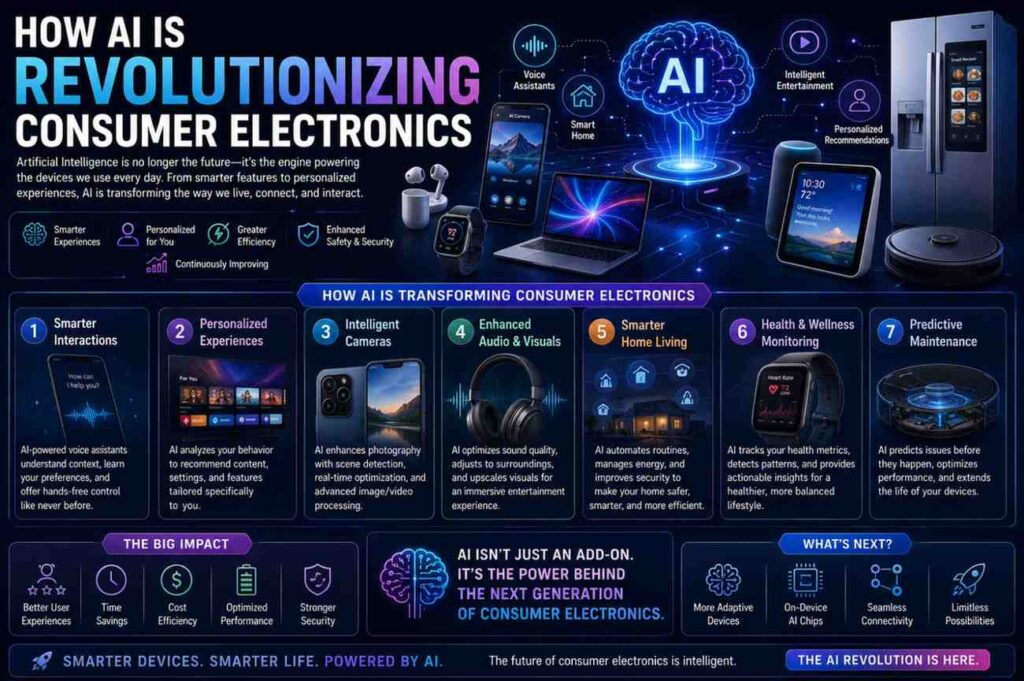
How AI is Revolutionizing Consumer Electronics
Artificial Intelligence is fundamentally transforming the consumer electronics industry by making devices smarter, more responsive, and highly personalized. From smartphones and smart TVs to wearable devices and home appliances, AI is enabling products that can learn from user behavior and adapt automatically to individual preferences. This shift is moving consumer electronics beyond static functionality toward intelligent, adaptive ecosystems.
One of the most significant changes AI brings is enhanced user experience through personalization. Modern devices can analyze usage patterns, voice commands, and interaction habits to deliver tailored recommendations, optimized settings, and predictive assistance. For example, smartphones can suggest apps based on daily routines, while smart TVs can recommend content aligned with viewing history.
AI is also improving automation and efficiency across consumer electronics. Devices can now perform tasks without manual input, such as adjusting brightness, optimizing battery usage, or managing smart home environments. This level of automation reduces effort for users while improving performance, energy efficiency, and overall convenience in everyday life.
Looking ahead, AI will continue to deepen its role in consumer electronics by enabling more seamless integration across devices and ecosystems. Future products will not only respond to commands but also anticipate needs, creating a more intuitive and connected digital environment. This evolution is set to redefine how people interact with technology in their daily lives.
Overview of AI in Consumer Electronics
Artificial intelligence has become one of the most transformative forces in modern consumer electronics. Today’s devices are no longer limited to fixed programming or basic automation. Instead, they are increasingly capable of learning from user behavior, adapting to preferences, and making intelligent decisions in real time. This shift is redefining what consumers expect from everyday gadgets and is reshaping the entire technology ecosystem into a more connected and intelligent environment.
In consumer electronics, this transformation is driven by the integration of machine learning models, data analytics, and real-time processing capabilities. These technologies allow devices to continuously analyze user interactions, identify behavioral patterns, and respond in ways that feel more natural, intuitive, and human-like. As a result, devices are becoming more responsive and context-aware than ever before.
Another major development is the rise of personalization in electronic devices. Instead of offering the same static experience to every user, modern systems now adapt dynamically based on individual preferences and habits. This includes personalized recommendations, adaptive system settings, and predictive features that anticipate user needs before they are explicitly expressed.
| AI Technology | What It Does | Real-World Use in Electronics | Example Device/Brand |
|---|---|---|---|
| Machine Learning (ML) | Learns from user behavior and improves over time | Personalized recommendations, predictive text, adaptive settings | Apple iPhone, Samsung Galaxy |
| Natural Language Processing (NLP) | Understands human speech and text commands | Voice assistants, chat commands, smart control | Google Assistant, Amazon Alexa |
| Computer Vision | Interprets images and visual data | Face recognition, camera enhancements, AR features | Apple Face ID, Samsung Camera AI |
| Edge AI | Processes data directly on device instead of cloud | Faster response, better privacy, offline intelligence | Modern smartphones, smart cameras |
| Predictive Analytics | Predicts user behavior using historical data | Battery optimization, health tracking insights | Wearables like Apple Watch |
What AI Means in Everyday Devices
Artificial intelligence in everyday consumer electronics refers to systems that can simulate human-like learning, reasoning, and decision-making. Rather than following only predefined instructions, AI-enabled devices can analyze data, recognize patterns, and adjust their behavior accordingly to improve user experience over time.
In practical terms, this is already visible in devices like smartphones, smart speakers, and wearable technology. Smartphones can automatically organize photos by recognizing faces and objects, while voice assistants can interpret natural language commands to perform tasks such as setting reminders or controlling smart home devices. These capabilities make technology more intuitive and easier to use.
AI also enables predictive functionality, allowing devices to anticipate user needs. For example, they can suggest apps based on daily routines, recommend music or videos based on past behavior, or provide timely reminders. This proactive assistance is making everyday interactions with technology more seamless and efficient.
Core Technologies Behind AI Devices
AI-powered consumer electronics rely on several core technologies that work together to create intelligent systems. Machine learning enables devices to improve their performance over time by learning from data, while natural language processing allows them to understand and respond to human speech more effectively.
Computer vision is another key technology that enables devices to interpret visual information. This powers features such as facial recognition, object detection, and augmented reality applications. These capabilities are now commonly found in smartphones, security cameras, and smart home systems.
Edge computing also plays a crucial role by processing data directly on the device instead of relying solely on cloud servers. This improves speed, reduces latency, and enhances privacy. Together, these technologies form the foundation of modern AI-driven consumer electronics, making devices smarter, faster, and more efficient.
Smart Homes and AI-Powered Automation
Smart home technology is one of the most visible and impactful applications of AI in consumer electronics. It transforms traditional living spaces into intelligent environments where devices are interconnected and capable of operating with minimal human intervention. This shift is redefining modern living by making homes more responsive, efficient, and adaptive to user needs.
AI enables automation across essential home functions such as lighting, temperature control, security systems, and entertainment devices. Instead of relying on manual inputs, smart systems can adjust settings automatically based on user behavior and environmental conditions. This enhances comfort, improves convenience, and contributes to better energy management.
Through IoT integration, smart home devices form a connected ecosystem where appliances communicate with each other seamlessly. Users can control these systems through mobile applications or voice commands, creating a unified and centralized home management experience that simplifies daily routines.
AI Voice Assistants in Smart Homes
AI voice assistants such as Amazon Alexa and Google Assistant play a central role in modern smart home ecosystems. They allow users to control multiple devices using natural language, eliminating the need for manual interaction or multiple control interfaces.
These systems continuously learn from user behavior and past interactions, allowing them to improve response accuracy and personalization over time. As a result, they become more intuitive and better at understanding user preferences and routines.
Today, voice assistants act as the primary control hub for many smart homes. They enable hands-free operation of lighting, entertainment systems, security devices, and appliances, making everyday tasks faster and more convenient.
Home Automation and IoT Integration
Home automation is powered by the combination of IoT sensors and AI algorithms working together. These sensors collect real-time data such as motion detection, temperature changes, and lighting conditions throughout the home environment.
AI systems then analyze this data to make intelligent decisions, such as adjusting thermostats based on occupancy or turning off lights in unused rooms. This level of automation reduces the need for manual control while improving efficiency and responsiveness.
The result is a highly seamless and interconnected living environment where devices work together intelligently. This not only improves convenience but also enhances overall system reliability and user comfort.
Energy Efficiency and Smart Control
AI-driven smart home systems play a significant role in optimizing energy consumption by continuously analyzing usage patterns and adjusting device behavior accordingly. This helps reduce unnecessary energy usage without compromising comfort or performance.
For example, smart thermostats can learn daily routines and automatically adjust heating or cooling based on when occupants are home or away. Similarly, smart lighting systems can dim or switch off automatically depending on room usage and natural light levels.
These intelligent adjustments contribute to lower energy bills and more sustainable living practices. Over time, AI-powered energy management systems help households reduce their environmental impact while maintaining optimal comfort and efficiency.
AI in Smartphones and Mobile Devices
Smartphones are among the most advanced and widely used examples of AI integration in consumer electronics. Artificial intelligence enhances multiple aspects of mobile devices, including photography, system performance, battery optimization, and user personalization. This makes smartphones more intelligent, efficient, and user-friendly than ever before.
Modern smartphones rely heavily on computational intelligence to analyze user behavior and improve overall device performance. Instead of functioning as static tools, they continuously adapt to user needs, making interactions smoother and more intuitive. AI also enables predictive capabilities that enhance responsiveness and overall usability.
Through these advancements, mobile devices are no longer just communication tools—they have evolved into intelligent assistants that anticipate user actions, optimize resources, and deliver highly personalized experiences.
| Device Category | AI Function | Benefit to Users | Example |
|---|---|---|---|
| Smartphones | Camera enhancement, battery optimization | Better photos, longer battery life | Apple iPhone, Samsung Galaxy |
| Smart Homes | Automation, voice control | Hands-free home control, energy savings | Amazon Alexa ecosystem |
| Wearables | Health monitoring, predictive analytics | Early disease detection, fitness tracking | Apple Watch, Fitbit |
| Entertainment Devices | Content recommendation engines | Personalized movies and music | Netflix, Smart TVs |
| Security Systems | Facial recognition, anomaly detection | Improved safety and privacy | Smart cameras, biometric locks |
AI-Powered Camera Enhancements
AI-powered camera systems have revolutionized mobile photography by automatically adjusting settings based on scene recognition, lighting conditions, and subject detection. This eliminates the need for manual configuration and allows users to capture professional-quality images effortlessly.
Features such as portrait mode, night mode, and HDR are driven by advanced AI-based image processing techniques. These systems enhance clarity, balance exposure, and improve color accuracy in real time, resulting in significantly better photo quality.
As AI continues to evolve, smartphone cameras are becoming increasingly capable of understanding complex visual environments, making photography more accessible and powerful for everyday users.
Battery Optimization and Performance
AI plays a crucial role in improving battery life and overall smartphone performance by analyzing how users interact with different applications. It identifies usage patterns and intelligently prioritizes energy consumption for essential tasks.
Background apps that are not actively needed are automatically managed or restricted, reducing unnecessary power usage. This helps extend battery life while ensuring smooth and consistent device performance throughout the day.
By optimizing system resources dynamically, AI ensures that smartphones remain efficient even under heavy usage, improving both speed and reliability.
Personalized User Experience
AI enables smartphones to deliver highly personalized user experiences by adapting notifications, app suggestions, and system settings based on individual behavior. This makes devices more intuitive and aligned with user preferences over time.
As users continue interacting with their devices, AI systems learn patterns and adjust functionality accordingly. This leads to smarter recommendations, better organization, and improved overall usability.
The result is a customized digital environment where each smartphone feels uniquely tailored to its user, enhancing convenience and engagement in everyday tasks.
Wearables and AI Health Monitoring
Wearable devices have evolved from simple fitness gadgets into advanced health monitoring systems powered by artificial intelligence. These devices continuously collect biometric data such as heart rate, sleep patterns, oxygen levels, and physical activity to generate meaningful insights about overall health and wellness.
AI plays a crucial role in transforming this raw data into actionable recommendations that users can easily understand and apply. Instead of just displaying numbers, modern wearables interpret patterns and trends to help users make better lifestyle and health decisions.
Through this intelligence-driven approach, wearable technology has become an essential part of preventive healthcare, enabling users to monitor their health more proactively and effectively.
Fitness Tracking with AI
AI-based fitness tracking analyzes user activity levels, workout intensity, and long-term progress to create a comprehensive picture of physical performance. It goes beyond simple step counting by evaluating the quality and effectiveness of exercise routines.
Based on this analysis, AI provides personalized fitness recommendations tailored to individual goals, such as weight loss, muscle gain, or endurance improvement. These suggestions help users train more efficiently and avoid ineffective workout patterns.
As a result, users are able to maintain consistency and achieve better health outcomes through data-driven fitness guidance and continuous performance tracking.
AI-Based Health Diagnostics
Modern wearable devices can detect potential health issues such as irregular heart rhythms, abnormal sleep patterns, or unusual stress levels using AI-powered algorithms. These systems analyze biometric signals in real time to identify possible risks.
Smartwatches and fitness trackers can alert users instantly when abnormal patterns are detected, enabling early awareness of potential health concerns. This real-time feedback can be critical in preventing serious health complications.
By integrating AI-based diagnostics, wearable devices are becoming valuable tools in early detection and preventive healthcare, bridging the gap between everyday monitoring and medical insight.
Predictive Health Analytics
AI uses long-term health data to predict potential risks and future health trends by analyzing subtle changes in biometric and behavioral patterns over time. This allows for a deeper understanding of a user’s overall health trajectory.
These predictive systems can identify early warning signs of issues such as fatigue, cardiovascular stress, or sleep disorders before they become severe. This enables users to take proactive steps toward improving their health.
With predictive analytics, wearable devices are shifting from reactive monitoring tools to proactive health management systems that support long-term wellness and early intervention strategies.
AI in Entertainment Devices
AI is playing a major role in transforming entertainment devices by making content more personalized, interactive, and engaging. From smart TVs to gaming consoles and streaming platforms, artificial intelligence is improving how users discover, consume, and experience digital entertainment.
Modern entertainment systems use AI to analyze user preferences, viewing habits, and interaction patterns. This allows devices to recommend relevant content and optimize performance, creating a smoother and more enjoyable entertainment experience overall.
By combining intelligence with automation, AI is turning traditional entertainment systems into adaptive platforms that continuously improve user satisfaction and engagement over time.
Smart TVs with AI Recommendations
Smart TVs now use AI algorithms to analyze viewing history, search behavior, and user preferences in order to suggest relevant shows, movies, and videos. This reduces the time users spend searching for content and improves discovery efficiency.
AI-driven recommendation systems ensure that content suggestions become more accurate over time as the system learns user interests. This results in a highly personalized viewing experience tailored to individual tastes.
As a result, smart TVs are no longer passive display devices—they have become intelligent entertainment hubs that actively guide content consumption.
Gaming Consoles and AI Optimization
AI is significantly enhancing gaming experiences by optimizing graphics performance, gameplay mechanics, and system responsiveness. Advanced algorithms help deliver smoother frame rates and more realistic visual effects.
In addition, AI can dynamically adjust game difficulty based on a player’s skill level. This ensures a balanced and engaging experience that is neither too easy nor too difficult, improving long-term player retention.
These intelligent optimizations make gaming consoles more adaptive, immersive, and enjoyable for users of all skill levels.
Content Personalization Engines
Streaming platforms such as video and music services rely heavily on AI-powered recommendation engines to personalize content for users. These systems analyze watch history, search behavior, and engagement patterns to suggest relevant content.
This personalization increases user engagement by helping individuals discover movies, shows, and music that match their interests. It also improves user satisfaction by reducing irrelevant recommendations.
Over time, these AI systems become more accurate, creating a highly customized entertainment experience that continuously evolves with user behavior.
AI in Entertainment Devices
AI is playing a major role in transforming entertainment devices by making content more personalized, interactive, and engaging. From smart TVs to gaming consoles and streaming platforms, artificial intelligence is significantly improving how users discover, consume, and experience digital entertainment in everyday life.
Modern entertainment systems now rely on AI to analyze user preferences, viewing habits, search history, and interaction patterns. This allows devices to recommend highly relevant content and optimize system performance in real time. As a result, users enjoy a smoother, more intuitive, and highly personalized entertainment experience.
By combining intelligence with automation, AI is transforming traditional entertainment systems into adaptive platforms that continuously evolve based on user behavior. This shift not only improves engagement but also enhances satisfaction by delivering content that feels uniquely tailored to each individual.
Smart TVs with AI Recommendations
Smart TVs now use advanced AI algorithms to analyze viewing history, watch duration, genre preferences, and even time-of-day usage patterns to suggest relevant shows, movies, and videos. This significantly reduces the time users spend searching for content and improves overall content discovery.
These recommendation systems become more accurate over time as they learn from user interactions. Each click, pause, or skip helps the AI refine its understanding of user preferences, resulting in increasingly personalized suggestions.
As a result, smart TVs have evolved from simple display devices into intelligent entertainment hubs that actively guide user choices and enhance viewing experiences.
Gaming Consoles and AI Optimization
AI is revolutionizing gaming consoles by improving graphics rendering, optimizing system performance, and enhancing gameplay mechanics. Advanced algorithms help deliver smoother frame rates, reduced latency, and more realistic visual effects, making games more immersive than ever before.
In addition, AI can dynamically adjust in-game difficulty based on a player’s skill level and performance history. This ensures a balanced gaming experience that keeps players engaged without making games too easy or overly challenging.
These intelligent optimizations allow gaming consoles to adapt in real time, creating more personalized and enjoyable experiences for casual and professional gamers alike.
Content Personalization Engines
Streaming platforms such as Netflix-style video services and music applications rely heavily on AI-powered recommendation engines to personalize content for each user. These systems analyze watch history, search behavior, likes, and engagement patterns to suggest highly relevant content.
This personalization greatly improves user engagement by helping individuals discover new movies, shows, and music that align with their interests. It also enhances satisfaction by minimizing irrelevant recommendations and improving content discovery efficiency.
Over time, these AI systems become increasingly precise, creating a continuously evolving entertainment experience that adapts to changing user preferences and habits.
The Future of AI in Consumer Electronics
The future of consumer electronics is deeply connected to continuous advancements in artificial intelligence. As AI technologies evolve, devices are becoming more autonomous, intelligent, and interconnected than ever before. This transformation is reshaping how users interact with technology in everyday life, making systems more intuitive and responsive.
Modern consumer electronics are shifting from simple tools into intelligent companions that can learn, adapt, and make decisions. This evolution is not only improving convenience but also enhancing efficiency, personalization, and overall user experience across all digital ecosystems.
As AI continues to develop, it will further blur the line between physical and digital environments, creating a future where devices seamlessly anticipate user needs and operate with minimal manual input.
Edge AI and Faster Processing
Edge AI refers to the processing of data directly on devices rather than relying on centralized cloud servers. This approach significantly reduces latency, allowing devices to respond faster and more efficiently in real time.
By processing data locally, Edge AI also enhances privacy and security, as sensitive information does not need to be constantly transmitted to external servers. This makes consumer electronics safer and more reliable for everyday use.
Overall, Edge AI improves performance, reduces dependency on internet connectivity, and enables smarter real-time decision-making within devices themselves.
Generative AI in Smart Devices
Generative AI is set to revolutionize smart devices by enabling them to create content, automate complex tasks, and interact more intelligently with users. This includes generating text, images, recommendations, and even personalized responses based on user behavior.
This technology will significantly enhance personalization by allowing devices to adapt dynamically to individual preferences and contexts. As a result, user experiences will become more natural, engaging, and highly customized.
In the future, smart devices will not only respond to commands but also proactively assist users by generating solutions, suggestions, and creative outputs in real time.
IoT and AI Convergence
The convergence of the Internet of Things (IoT) and artificial intelligence is creating fully connected smart ecosystems where all devices work together seamlessly. This integration allows appliances, sensors, and systems to communicate and coordinate without human intervention.
Through this connectivity, homes, offices, and cities will become more intelligent and automated. Devices will share data in real time to optimize performance, energy usage, and user experience across entire environments.
This evolution will fundamentally redefine how humans interact with technology, shifting from device-by-device control to fully integrated, intelligent ecosystems that operate as unified systems.
Frequently Asked Questions
The Frequently Asked Questions (FAQ) section is designed to provide quick, clear, and reliable answers to the most common queries related to the topic. Instead of going through the full content, readers can use this section to understand key concepts in a simplified and direct format. It helps summarize important points and makes complex information easier to digest.
FAQs are especially useful for improving clarity and accessibility. They address the most relevant concerns users may have, such as definitions, benefits, challenges, and real-world applications. By grouping common questions together, this section saves time and helps readers quickly find the information they are looking for without needing to search through the entire article.
How is AI used in consumer electronics?
AI is used in consumer electronics to enhance device intelligence through automation, personalization, voice recognition, and predictive analytics. It enables devices to learn from user behavior and continuously improve performance and user experience.
This technology is widely applied in smartphones, smart home systems, wearables, and entertainment devices, making them more efficient, adaptive, and user-friendly in everyday life.
What are examples of AI smart devices?
Common examples of AI-powered smart devices include smart speakers, smartphones, smart TVs, wearable fitness trackers, and automated home systems. These devices use AI to process data and deliver smarter, more personalized functionality.
They are designed to simplify daily tasks by offering automation, intelligent recommendations, and real-time responses based on user preferences and behavior patterns.
How does AI improve smartphones?
AI improves smartphones by enhancing camera performance, optimizing battery life, strengthening security features, and enabling personalized user experiences. It allows devices to automatically adjust settings based on usage patterns.
Through continuous learning, smartphones become more efficient and intuitive over time, offering features such as smart photo enhancement, predictive text, and adaptive system optimization.
Is AI in home appliances useful?
Yes, AI in home appliances is highly useful as it improves automation, reduces energy consumption, and increases overall convenience. Smart appliances can adjust their behavior based on user habits and environmental conditions.
For example, AI-powered thermostats, lighting systems, and security devices can operate automatically, making homes more efficient, comfortable, and secure with minimal manual effort.
What is the future of AI in gadgets?
The future of AI in gadgets involves deeper integration with IoT, the rise of edge computing, and the expansion of generative AI capabilities. Devices will become more autonomous and capable of making intelligent decisions in real time.
In the coming years, gadgets will evolve into highly interactive and predictive systems that understand user needs proactively, offering a more seamless and human-like technology experience.
Conclusion
Artificial intelligence is transforming consumer electronics by making devices smarter, more efficient, and more personalized. From smartphones and wearables to smart home systems and entertainment devices, AI is fundamentally redefining how modern technology is designed, used, and experienced.
This transformation is not only technical but also deeply practical, as it directly improves everyday life through automation, predictive intelligence, and adaptive functionality. Devices are no longer static tools; they are becoming intelligent systems that learn, respond, and evolve with user behavior.
As AI continues to advance, consumer electronics will become even more interconnected and autonomous, creating a future where technology seamlessly integrates into daily routines and enhances convenience, productivity, and overall quality of life.